
Expense reimbursement policy: rules and sample workflow
Quick answer: A good expense reimbursement policy answers six questions in plain language: what expenses are reimbursable, how much can be spent (limits per category), what proof is needed (receipts and tax invoices), who approves and up to what amount, when claims must be submitted and paid, and what happens if the rules are not followed. Keep it to two or three pages, use a single claim form, require receipts for every item, ask for full tax invoices where VAT can be recovered, and pay approved claims on a fixed schedule.
Without a policy, expense claims become a source of friction: employees do not know what they can claim, managers approve inconsistently, and finance chases missing receipts every month. A short, clear policy fixes this and protects the business from overspending and VAT losses.
Why your business needs a written policy
- Fairness: everyone follows the same rules; no favouritism.
- Cost control: limits stop overspending on hotels, meals and taxis.
- VAT recovery: requiring tax invoices recovers 5% input VAT on eligible business expenses, which adds up over a year.
- Faster processing: standard forms and deadlines mean finance spends less time chasing.
- Audit readiness: every reimbursement is supported by documents, which matters for VAT and corporate tax records.
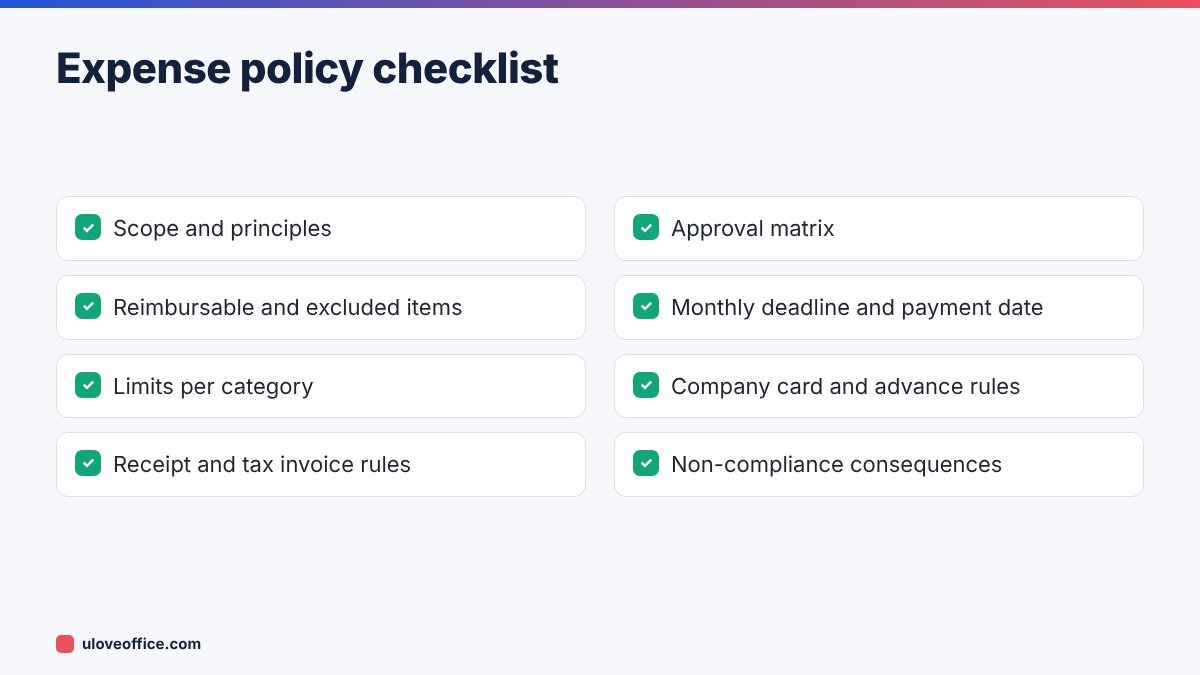
Section 1: Scope and principles
Start with a short statement:
“The company reimburses reasonable, necessary expenses incurred wholly for business purposes, with prior approval where required. Employees should spend company money as carefully as their own.”
State who the policy applies to (all employees, and contractors where agreed) and that it works alongside the travel policy, company card policy and procurement policy if you have them.
Section 2: What is reimbursable
List the common categories with clear rules:
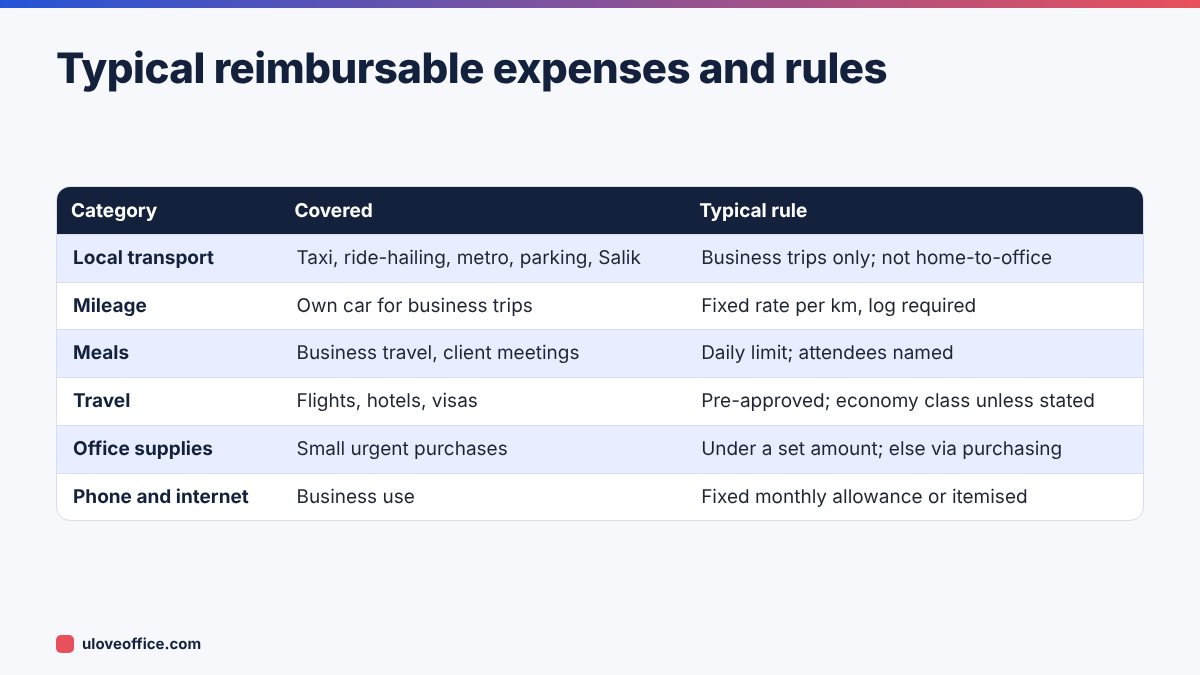
Also list what is not reimbursable: personal items, traffic fines, alcohol (if your policy excludes it), family members’ travel, upgrades without approval, gym memberships unless part of benefits, and lost-receipt items above a threshold.
Section 3: Limits
Set limits per category in AED, for example a daily meal allowance during business travel, a maximum hotel rate per city, and an amount above which small purchases must go through purchasing. Review limits every year.
Two common approaches:
- Actual cost up to a limit: the employee claims what they spent, with receipts, up to the cap.
- Per diem: a fixed daily amount for meals and incidentals when travelling, without itemised receipts for each meal. Simpler to administer, but check how your accountant wants to treat it.
Section 4: Receipts and tax invoices
This is where many policies are too vague. Be precise:
- Every claim needs a receipt showing the supplier, date, items and amount. Card slips alone are not enough.
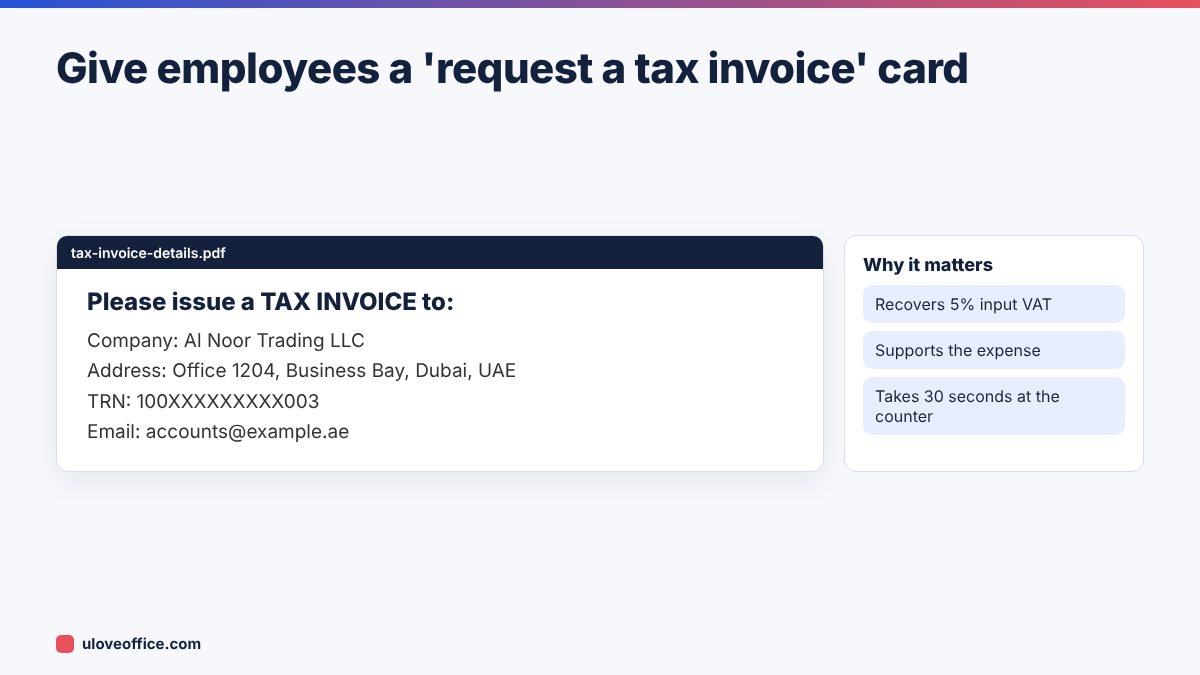
- For VAT-recoverable expenses above a set amount, the employee must request a full tax invoice in the company’s name and TRN. Give employees a small card or phone note with the company’s legal name, address and TRN.
- Photos and PDFs are accepted. Employees should photograph paper receipts on the day; thermal paper fades.
- Lost receipts: allow a signed declaration for small amounts only, with a monthly cap.
Our guide on organising business expense receipts in the UAE explains how to capture and name receipts. Employees can combine all receipts into one file with JPG to PDF and Merge PDF.
Section 5: Approvals
Set an approval matrix:
- Claims up to a set amount: approved by the line manager.
- Higher claims: approved by the department head or finance manager.
- Claims by managers: approved by their own manager, never by themselves.
- Travel and hotels: pre-approved before booking.
Approvers check that the expense was for business, is within policy and is supported. Finance checks receipts, VAT treatment and coding.
Section 6: Deadlines and payment
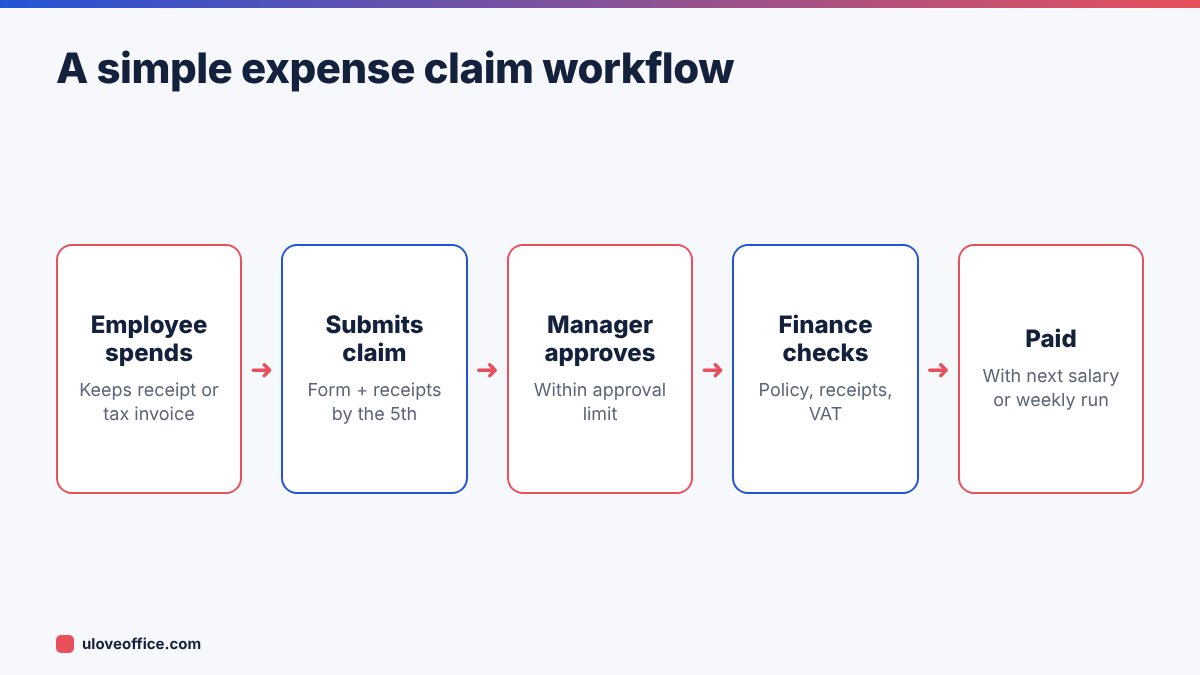
- Submit claims monthly, by a fixed date such as the fifth working day of the following month.
- Claims older than a set period (for example 60 days) may be rejected unless there is a good reason.
- Approved claims are paid with the next salary run or in a weekly payment run. State which.
- Reimbursements are not salary. Keep them separate from salary in your records, even if paid together.
Section 7: Company cards and advances
If employees use company credit cards:
- The same receipt rules apply; the card statement is not a receipt.
- Personal use is not allowed; any personal transaction must be repaid immediately.
- Monthly card reconciliation is due by the same deadline as claims.
For cash advances (for example before a trip), require settlement within a set number of days after return, with receipts and any unused cash returned.

Section 8: Non-compliance
State consequences clearly but fairly: claims outside policy are rejected or reduced; repeated issues are discussed with the employee; deliberate false claims are treated as misconduct under the disciplinary policy.
The claim form
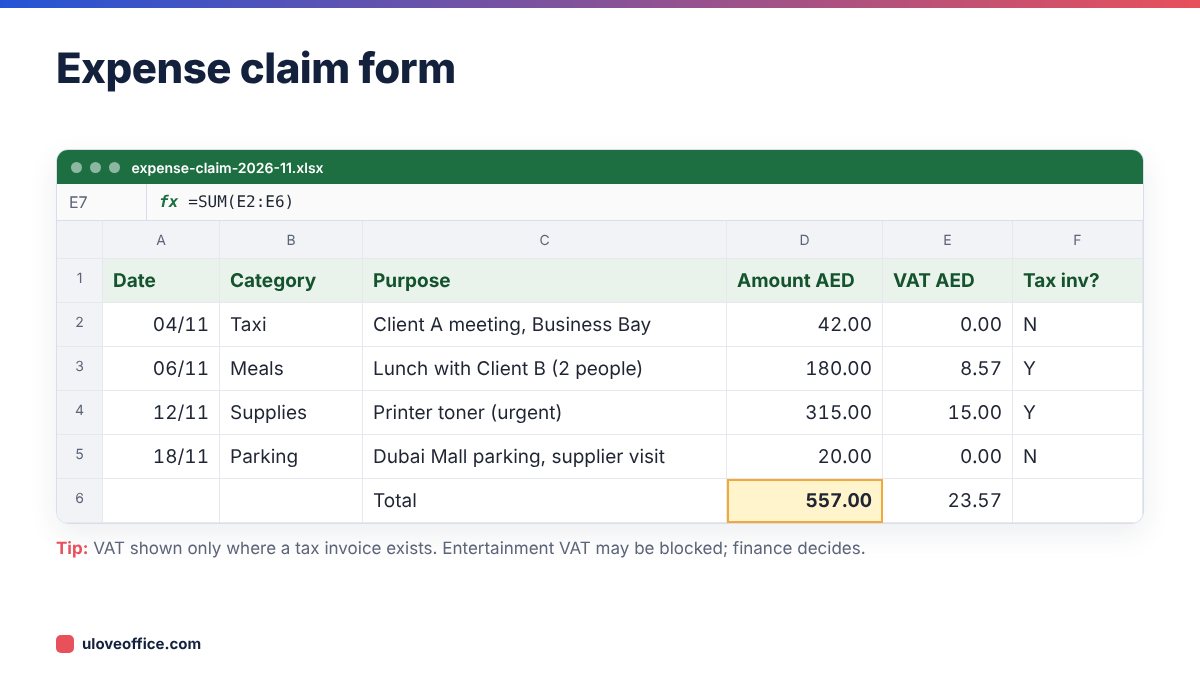
Use one Excel or online form with these columns:
| Date | Category | Description / purpose | Supplier | Amount (AED) | VAT on invoice (AED) | Tax invoice? (Y/N) | Receipt file name |
Add the employee name, department, period, total and declaration: “I confirm these expenses were incurred for business purposes and have not been claimed elsewhere.” Lock formula cells and use drop-downs for category and Y/N; see our guide on creating a drop-down list in Excel.
VAT points for finance
- Input VAT is generally recoverable only with a valid tax invoice and for business use.
- Some categories are blocked, such as entertainment for non-employees and certain staff benefits. Mark them for review.
- International flights are zero-rated, so there is no VAT to recover.
- Keep claims and receipts for the full record retention period.
Worked example: rolling out the policy
A 40-person Dubai consultancy had no written policy. Claims arrived months late, with photos of card slips and no tax invoices. Finance wrote a three-page policy using the sections above, set limits after reviewing the previous year’s claims, gave every employee a tax invoice card and a single Excel form, and announced a monthly deadline. In the first quarter, late claims dropped sharply, recoverable input VAT on claims rose because more tax invoices were collected, and month-end processing time halved.
Handling common grey areas
Every policy meets situations it did not anticipate. Decide your answer to these in advance and add them to the policy:
- Working late meals: are dinners reimbursed when staff work past a certain time? Set the time and the limit.
- Client entertainment: who may entertain clients, how many staff may attend, and the per-person limit. Require the client’s name and company on the claim.
- Team celebrations: birthdays and farewells are often paid from a small department budget, not individual claims.
- Mobile phone use: a fixed monthly allowance is easier to manage than itemised bills.
- Home office equipment: whether staff working from home can claim chairs, monitors or internet, and whether the company owns the equipment afterwards.
- Visa and document fees for staff: these are employer costs under UAE Labour Law; process them through HR, not personal claims.
- Upgrades and loyalty points: personal loyalty points earned on business travel are usually allowed, but upgrades paid by the company need approval.
Making approvals fast
Slow approvals frustrate employees and delay month-end. Practical fixes: managers approve within three working days of submission, finance processes approved claims weekly, and claims under a small threshold are approved by finance only, with a monthly spot-check. If you use an accounting or HR app with mobile approvals, managers can approve from their phones between meetings.
Communicating the policy
Share the policy in a short team briefing, not just an email. Walk through the claim form, show the tax invoice card and explain the deadline. Put the policy and form in the shared templates folder, include them in onboarding for new joiners, and remind everyone of the deadline a few days before each month end. When you update limits, announce the change and the effective date clearly.
Key takeaways
- Keep the policy short, specific and written in plain language.
- Require receipts for every item and full tax invoices for VAT-recoverable expenses.
- Set limits and an approval matrix, and never let people approve their own claims.
- Use one claim form and one monthly deadline.
- Review limits and rules every year.
📘 Continue reading
Frequently asked questions
Should we use per diems or actual costs?
Per diems are simpler for frequent travel; actual costs give tighter control. Many businesses use per diems for meals and actual costs for hotels and transport.
Can we reimburse expenses without receipts?
Only small amounts with a signed declaration, within a monthly cap. Otherwise no.
Are reimbursements part of salary?
No. Reimbursements repay business costs; keep them separate from wages in payroll records.
How do we handle foreign currency expenses?
Reimburse at the card statement rate or a stated exchange rate source, and attach the card statement line.
Conclusion
An expense reimbursement policy works when it is short, specific and consistently applied. Define what is covered, set limits, require receipts and tax invoices, use a clear approval matrix and a single monthly deadline. Employees get paid back faster, managers approve with confidence, and the business keeps more of its VAT.
Last checked: 9 November 2026. General information only; confirm VAT treatment with your accountant.