
Employee handover checklist: what to hand over before leaving
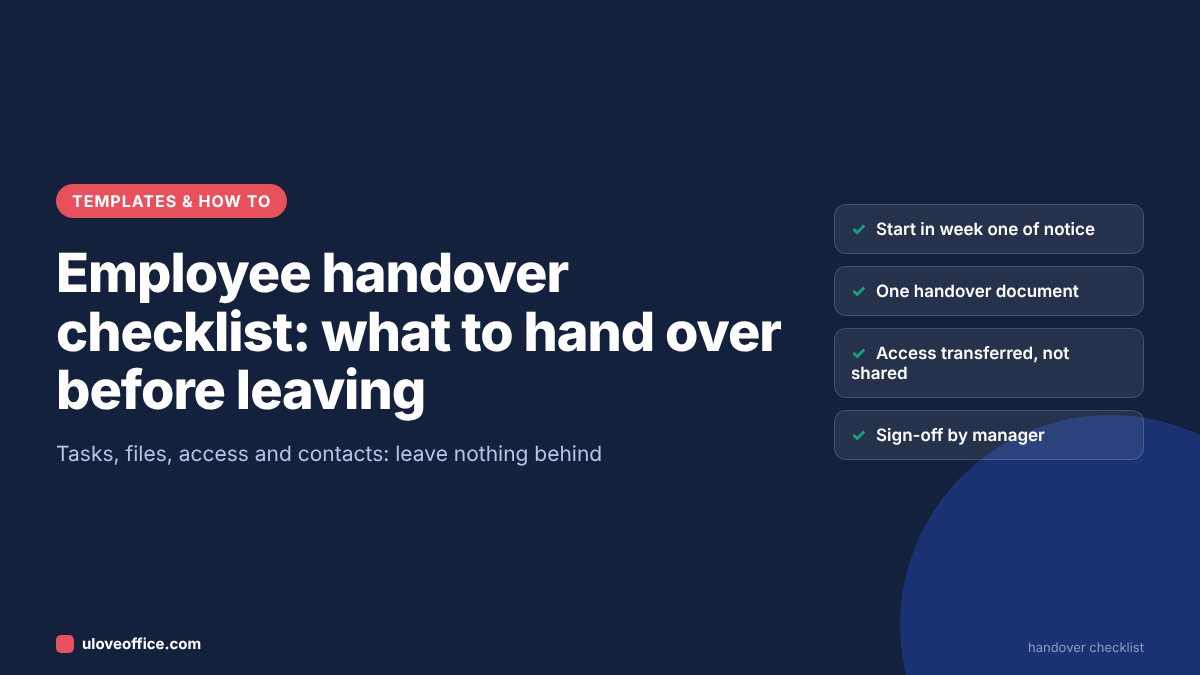
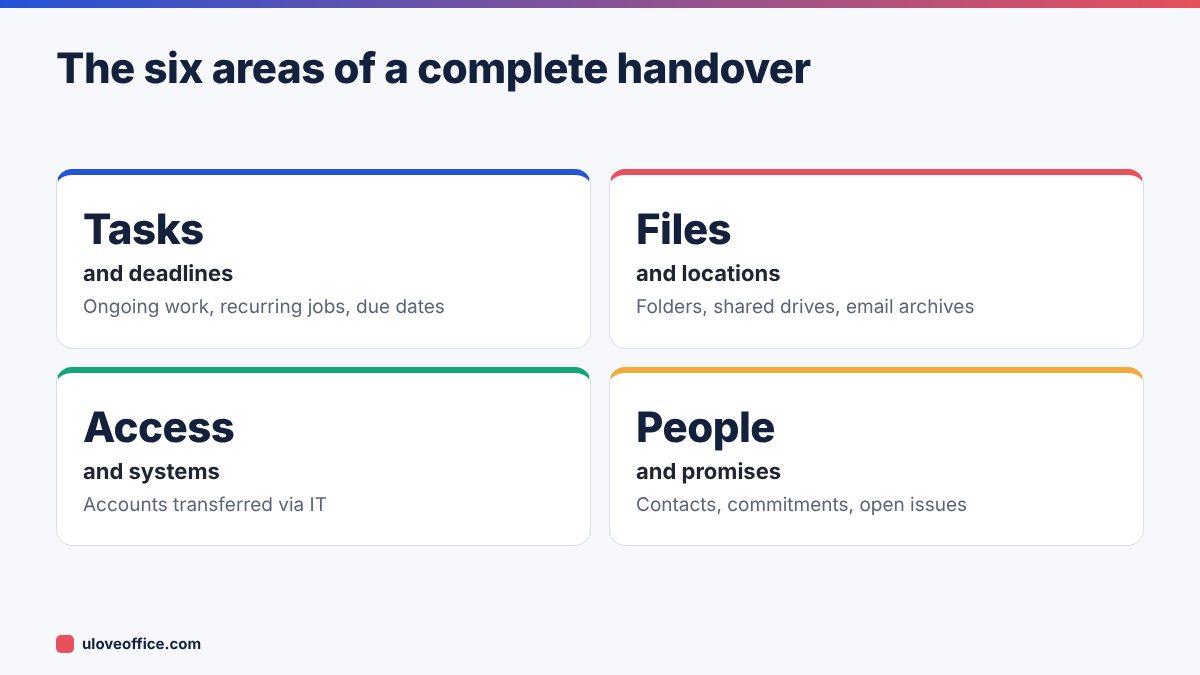
Quick answer: A good handover covers six areas: ongoing tasks and deadlines, files and where they live, systems and access (transferred through IT, never by sharing passwords), key contacts inside and outside the company, pending issues and promises made to clients or suppliers, and company property to return. Start the handover in the first week of the notice period, write one handover document, walk your successor or manager through it, and get it signed off before your last day.
Whether you are the person leaving or the manager receiving the handover, a structured process prevents the classic problems: missed deadlines, clients who feel abandoned, files nobody can find and systems locked behind an ex-employee’s password. In the UAE, where notice periods are usually 30 to 90 days, there is enough time to do it properly if you start early.
Why handovers fail
Most handovers fail for predictable reasons:
- They start in the last week, when the leaver is busy finishing work and saying goodbyes.
- They exist only as a conversation, which the successor half-remembers.
- Nobody owns them: HR thinks the manager is doing it, the manager thinks HR is.
- Passwords are written on a sticky note instead of access being properly transferred.
- Informal knowledge, like “this client always pays late but calls first”, is never written down.
The fix is a written handover document, started early, with a clear owner and a sign-off.
When to start
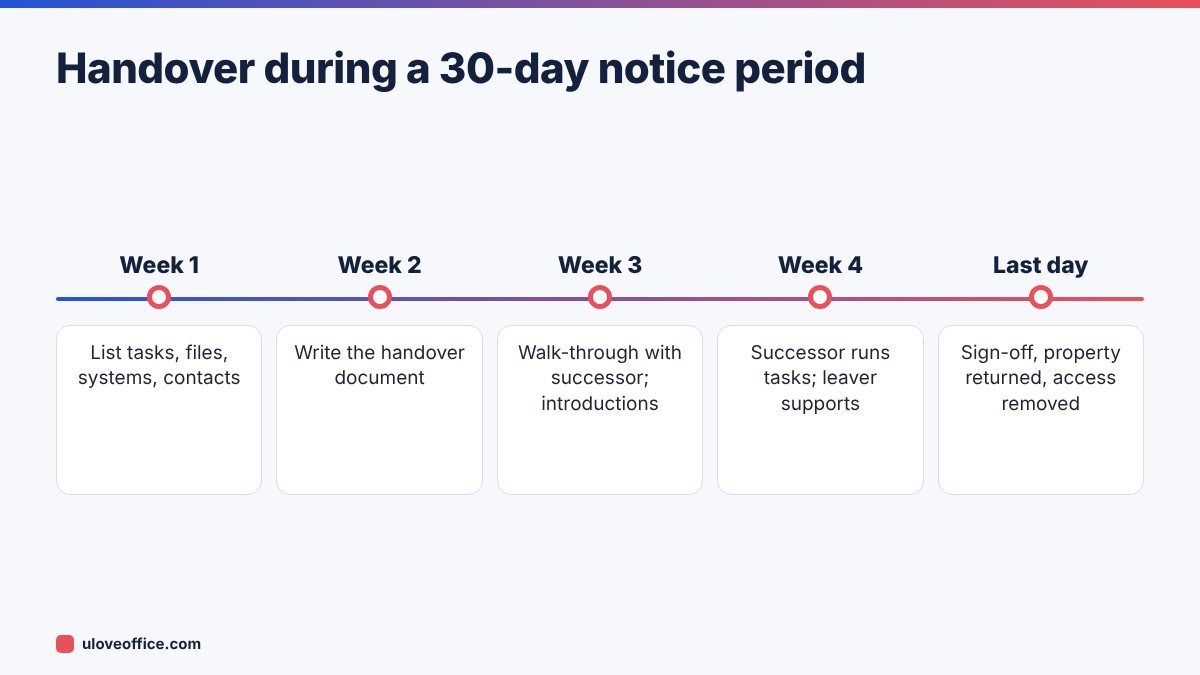
The manager should agree the handover plan with the leaver within the first few days of the notice period, including who will receive each area of work. If there is no successor yet, the manager receives the handover and assigns it later.
The handover checklist
1. Tasks and responsibilities
- List every ongoing task and project with its status, next step and deadline.
- List recurring tasks: daily, weekly, monthly, quarterly and annual (for example, the monthly VAT reconciliation, the annual licence renewal reminder).
- Note how each task is done: the steps, templates and systems used. Link to any written procedures.
- Flag tasks only you know how to do. These need a written procedure before you leave.
2. Files and documents
- Move work files from your desktop, downloads and personal drive to the shared team location.
- Write a short folder map: where each type of document lives.
- Identify important emails and move them to shared folders, or arrange for mailbox access to be delegated after you leave (through IT).
- Hand over physical files and their location.
- Delete personal files from company devices, and do not take company files with you.
3. Systems and access
- List every system you use: accounting software, CRM, bank portals, government portals, supplier portals, social media accounts, domain and hosting accounts.
- For each, note who should take over and ask IT or the system owner to transfer access.
- Do not hand over your personal passwords. Shared company accounts should have their passwords changed after you leave.
- Transfer admin rights for any system where you are the only admin. This is often forgotten and can lock the company out of its own website or social media.
- Return tokens, such as bank authentication devices.
4. Contacts and relationships
- List key internal contacts and what you work on with them.
- List key external contacts (clients, suppliers, consultants, government contacts) with their role and the current status of the relationship.
- Introduce your successor by email or in a meeting to the most important external contacts.
- Note any commitments or promises you made, such as “promised Client A a revised quotation by 15 December”.
5. Pending issues
- Open complaints or disputes, with history and next steps.
- Unpaid invoices you were chasing.
- Approvals waiting on you.
- Upcoming renewals and deadlines: contracts, licences, subscriptions, warranties.
6. Company property
- Laptop, phone, chargers, access card, keys, parking card, company credit card, uniforms, tools.
- Return everything against a signed list.
The handover document
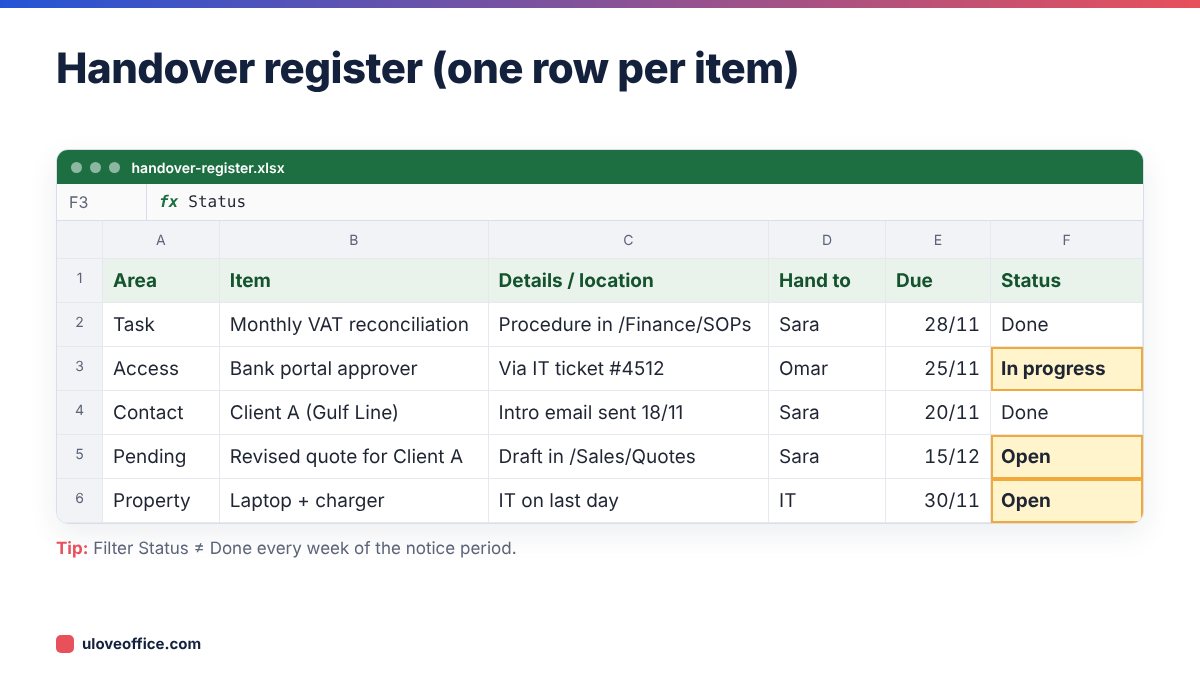
Alongside the register, write a short handover document (three to ten pages for most roles). A useful structure:
- Role summary: what the job is for, in a paragraph.
- Weekly and monthly calendar: what happens when.
- Ongoing work: each project with status and next steps.
- How-to notes for key processes, or links to procedures.
- Systems and access: what was transferred to whom.
- Contacts: internal and external, with notes.
- Pending issues and commitments.
- Tips: the informal knowledge (“Supplier X needs POs before 2 pm to deliver next day”).
Write it in Word, then save a final version with Word to PDF. Keep the editable version in the team folder so the successor can update it.

For managers: running the handover
- Agree the plan in week one, with dates.
- Assign successors for each area.
- Check the register weekly.
- Attend at least one walk-through.
- Ask IT to schedule access removal for the last day and confirm admin rights have been transferred beforehand.
- Sign off the handover document with the leaver on their last day.
Remember the final settlement (gratuity, leave, notice pay) and the experience certificate are the employer’s obligations regardless of how the handover went. A smooth, respectful exit protects the company’s reputation; former employees are often future clients, partners or rehires. Our guide to the UAE final settlement explains the calculation.
For employees: doing it well
A strong handover protects your reputation. Managers remember who left things in order. Tips:
- Start early, even if you do not feel like it.
- Write things down as you do your normal work in the notice period: each time you do a task, add the steps to the document.
- Be honest about problems you are leaving behind.
- Do not take company data, and do not delete work emails or files.
- Ask your manager for an experience certificate before your last day.
If you have not yet resigned, our guide on how to write a resignation letter in the UAE covers the letter and notice rules.
Common mistakes
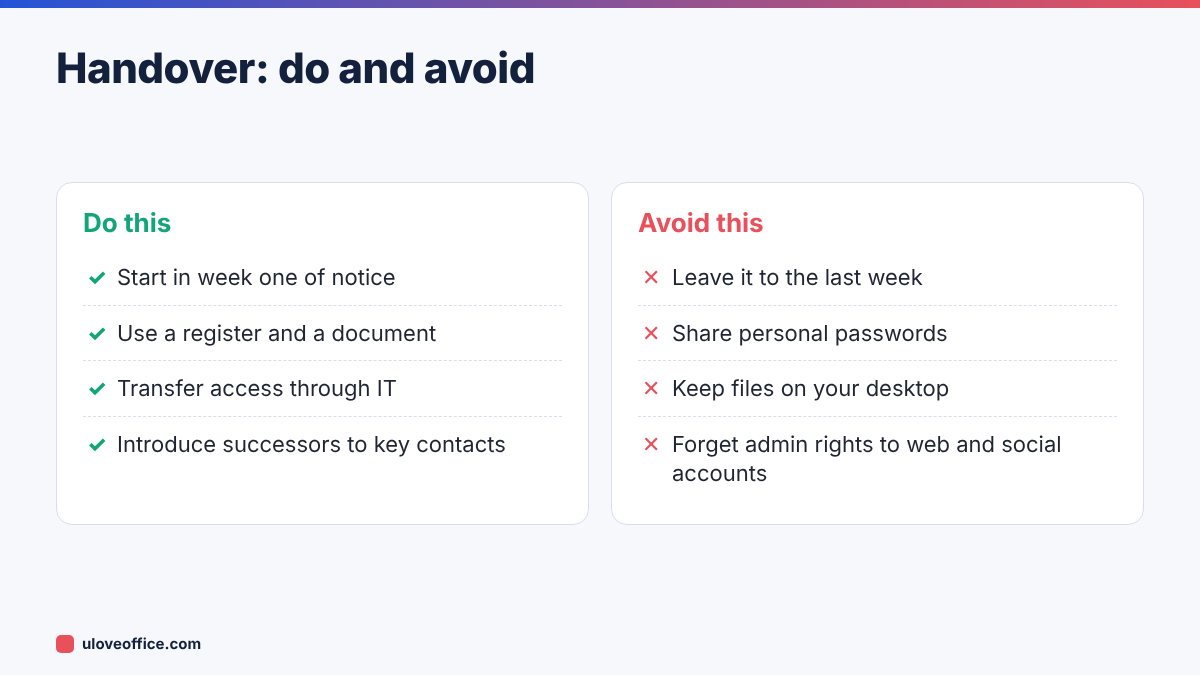
Handover by role: what is easy to forget
Different roles have different blind spots. Add these to the checklist where relevant:
- Finance: bank portal approvals, payment authorisation limits, VAT and corporate tax portal access, recurring payment schedules, post-dated cheques in the drawer, the auditor’s contact and open audit queries.
- Sales: CRM ownership of accounts, quotations awaiting reply, promised discounts, commission disputes, customer WhatsApp groups that should move to a company number.
- HR and admin: visa and Emirates ID renewal reminders, insurance renewals, PRO contacts, the holiday table for attendance, MOHRE and immigration portal access.
- IT and marketing: domain and hosting renewals, admin rights to the website, Google and Meta business accounts, social media logins, analytics access, two-factor authentication devices.
- Operations: supplier lead times, warehouse procedures, equipment maintenance schedules, safety records.
Most of the painful surprises after someone leaves come from this list. Two-factor authentication linked to a personal mobile number is a common one: move it to a company device before the last day.
A handover sign-off form
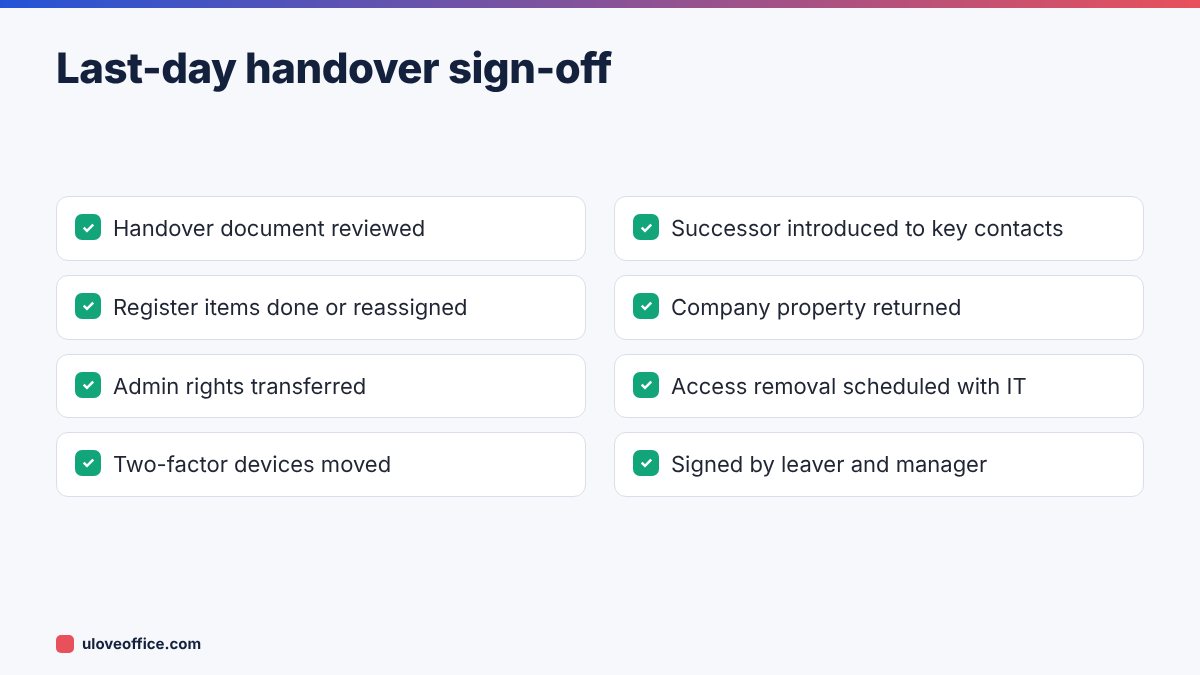
On the last day, the leaver and the manager sign a one-page form confirming that the handover document has been reviewed, the register is complete or the remaining items are assigned, access has been transferred and property returned. HR keeps it on the employee file with the final settlement paperwork.
Key takeaways
- Treat the handover as a project with a plan, owners and dates.
- Cover tasks, files, access, contacts, pending issues and property.
- Transfer access properly; never hand over personal passwords.
- Write the informal knowledge down, not just the formal procedures.
- Sign off the handover before the last day.
Using the handover for the next hire
A good handover document is also the starting point for the next person in the role. Keep it in the team folder, ask the successor to update it during their first month, and use it in their onboarding. Over time it becomes a living role guide, so the next handover takes days instead of weeks. Our employee onboarding checklist explains how to plan a successor’s first 90 days.
📘 Continue reading
Frequently asked questions
Can an employer withhold the final settlement until the handover is complete?
The final settlement has legal deadlines and conditions under UAE Labour Law; withholding it as leverage is risky. Take advice and focus on planning the handover early instead.
What if the employee is leaving on bad terms?
Keep it factual and supervised. Arrange access transfer with IT early and focus on essential items.
What if there is no successor?
Hand over to the manager, who assigns work later. The document becomes even more important.
How long should a handover document be?
Long enough to cover the role clearly; for most roles three to ten pages plus the register.
Handovers are also a test of how well the business documents its own processes. If every handover reveals undocumented tasks, use that as a prompt to write procedures for them now.
Conclusion
A handover checklist turns a risky moment into a routine one. Start in the first week of notice, list everything in a register, write a concise handover document, transfer access through IT, introduce successors to key contacts and sign it off before the last day. The business keeps running, and the person leaving goes with their reputation intact.
Last checked: 9 November 2026.