
UAE final settlement: how to calculate gratuity, leave salary and notice pay
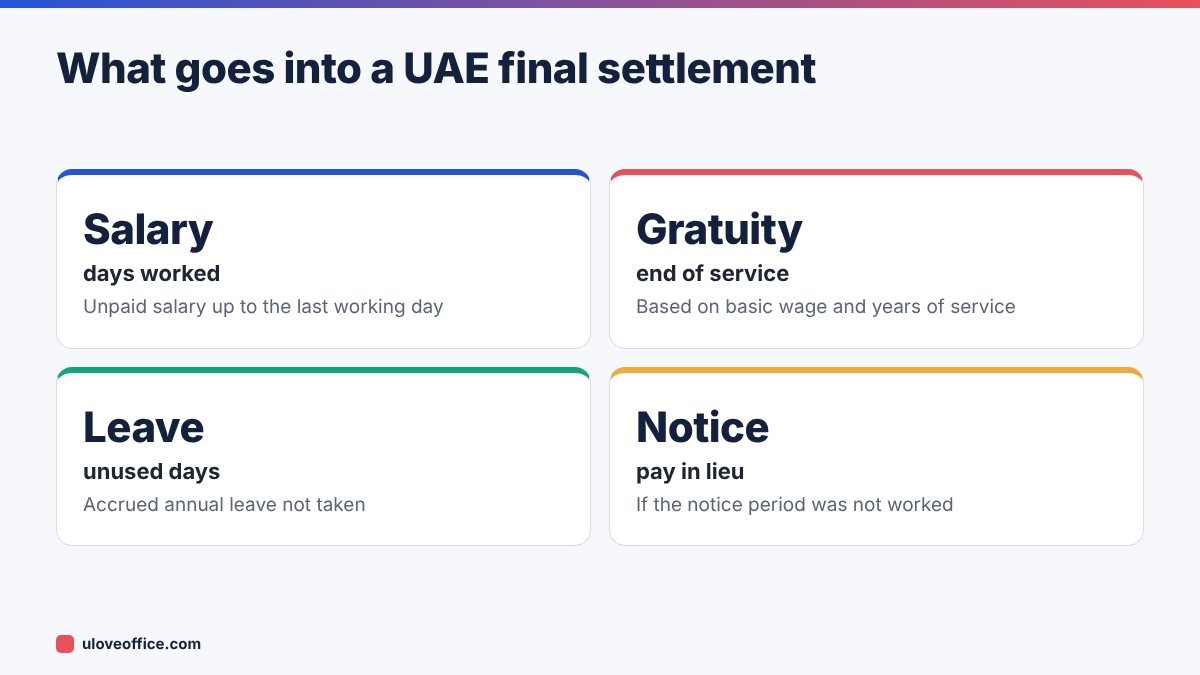
Quick answer: A UAE final settlement usually includes five parts: salary for days worked in the last month, end-of-service gratuity, payment for unused annual leave, notice pay if notice was not worked, and other dues such as a repatriation ticket, minus any lawful deductions like unpaid advances. Under Federal Decree-Law No. 33 of 2021, gratuity is 21 days of basic wage per year for the first five years and 30 days per year after that, capped at two years’ wage, and all dues must be paid within 14 days of the end of employment.
Final settlements cause more disputes between employers and employees in the UAE than almost any other HR task, usually because one component is forgotten or calculated on the wrong salary. This guide walks through each part and ends with a full worked example you can copy.
This guide covers private-sector employees under the federal UAE Labour Law, which applies on the mainland and in most free zones. DIFC and ADGM have their own employment laws (DIFC uses the DEWS savings scheme instead of gratuity), and UAE and GCC nationals are usually covered by pension schemes rather than gratuity. Check which rules apply before you calculate.
Component 1: Salary for days worked
Pay the employee for every day worked in the final month that has not yet been paid. A common method is:
Daily wage = monthly gross salary ÷ 30, then multiply by days worked.
If the employee leaves on the 10th and earns AED 13,000 a month in total, that is 13,000 ÷ 30 × 10 = AED 4,333.33. Include allowances that are part of the monthly wage, such as housing and transport, as set out in the contract.
Component 2: End-of-service gratuity
Gratuity is due to full-time employees who have completed at least one year of continuous service. It is calculated on the last basic wage, not the total package.
- Years 1 to 5: 21 days of basic wage for each year.
- Year 6 onwards: 30 days of basic wage for each additional year.
- Part years: paid in proportion to the time worked, once the first year is complete.
- Cap: total gratuity cannot exceed two years’ wage.
Under the 2021 law, the amount is the same whether the employee resigns or is terminated, as long as the conditions are met. The old reductions for resigning under limited or unlimited contracts no longer apply to contracts governed by the new law.
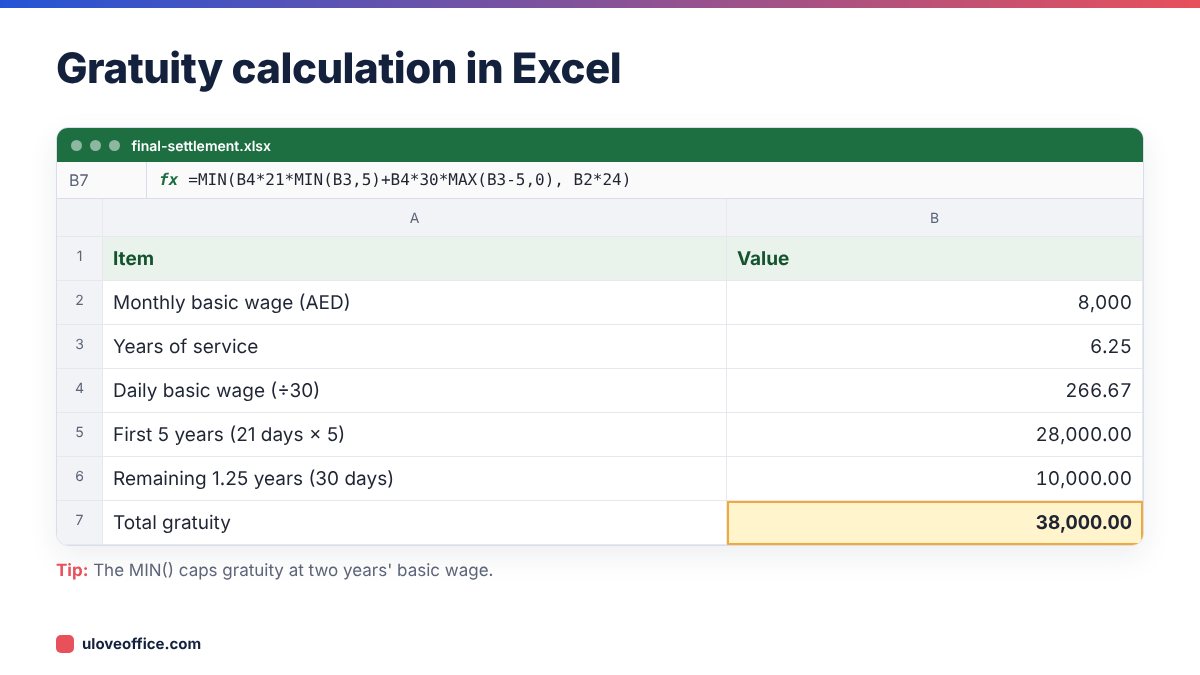
You can check the result with our free UAE Gratuity Calculator, which follows the same rules.
Daily wage convention: many employers divide the monthly basic by 30. Some divide the annual basic by 365. The difference is small, but pick one method, write it in your HR policy and use it consistently.
Component 3: Unused annual leave
Employees earn 30 calendar days of annual leave per year after the first year of service, and two days per month after six months in the first year. Leave that has not been taken by the end of employment must be paid.
Payment for untaken leave on exit is generally calculated on the basic wage. So: unused days × (monthly basic ÷ 30). Check the employment contract too, because a more generous contractual term applies over the legal minimum.
Example: 12 unused days × (8,000 ÷ 30) = AED 3,200.
Component 4: Notice pay
The notice period is set in the contract, between 30 and 90 days. If either side ends the contract without working the full notice period, the party that cut it short pays compensation equal to the wage for the unworked part of the notice.
- If the employer asks the employee to leave immediately, the employer pays the notice period.
- If the employee leaves without serving notice, the employer can claim the equivalent, often by deduction from the settlement if the contract and law allow.
Notice pay is usually based on the full wage the employee was receiving, not just basic. Read the contract wording. Our guide to UAE notice period rules covers the details.

Component 5: Other dues
- Repatriation ticket: the employer generally bears the cost of the employee’s return ticket to their home country, unless the employee joins another employer in the UAE or the contract says otherwise.
- Overtime not yet paid. Use our Overtime Pay Calculator to check it.
- Commissions or bonuses that are earned and payable under the contract or policy.
- Expense reimbursements that are approved but unpaid.
Deductions
The employer may deduct only amounts the law allows, such as:
- Salary advances or loans to the employee.
- Amounts owed under a court judgment.
- Notice pay owed by the employee, where applicable.
- The value of company property not returned, where permitted and documented.
Deductions must be clearly itemised. Never deduct visa cancellation costs or recruitment fees from the employee; those are the employer’s costs.
Full worked example
Fatima has worked for a Dubai trading company for 6 years and 3 months. Her basic wage is AED 8,000 and her total monthly wage is AED 13,000. She resigns, but the company asks her to leave immediately instead of working her 30-day notice. Her last working day is the 10th of the month. She has 12 days of unused leave and owes AED 2,000 from a salary advance.
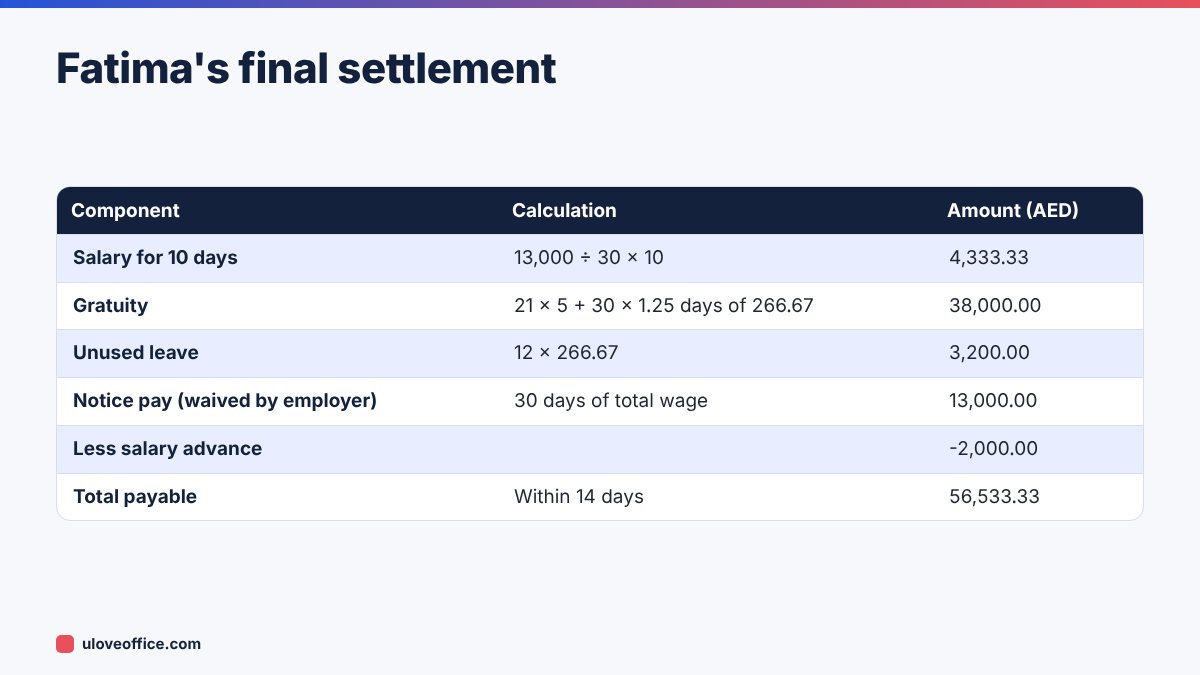
Fatima’s settlement is AED 56,533.33, payable within 14 days of her last working day. If the company had let her work the 30-day notice, there would be no notice pay, but she would have earned another month’s salary and slightly more gratuity.
Special cases to watch
Unpaid leave and absences. Days of unpaid absence are generally not counted as service for gratuity. If an employee took a month of unpaid leave, reduce the service period by that month before calculating.
Part-time employees. Gratuity for part-time workers is calculated in proportion to the hours actually worked. Check the part-time contract and the Executive Regulations.
Salary changes during employment. Gratuity uses the last basic wage, not an average. If the basic wage increased in the final year, the higher figure applies to the whole service period.
Death of an employee. Dues, including gratuity, are paid to the employee’s family or heirs. Handle these cases with care and follow official guidance on who receives payment.
Contracts that started under the old law. Employees who moved from the previous labour law to the 2021 law keep the service they had built up. Gratuity for earlier periods can depend on the transition rules, so take advice for long-serving staff with older contracts.
Employer-paid savings schemes. Some employers have joined approved alternative end-of-service savings schemes. Where an employee is enrolled, the scheme rules replace part or all of the traditional gratuity for the relevant period.
Checklist before you pay
Before releasing payment, confirm that you have:
- The correct last working day and the reason the contract ended.
- The latest basic and total wage from payroll, not from the original offer letter.
- An up-to-date leave balance from your HR system or leave register.
- Records of any advances, loans or unreturned company property.
- The employee’s bank details for the final payment.
- A clear note of who approved the settlement and when.
Running these checks takes ten minutes and prevents most complaints.
Key takeaways
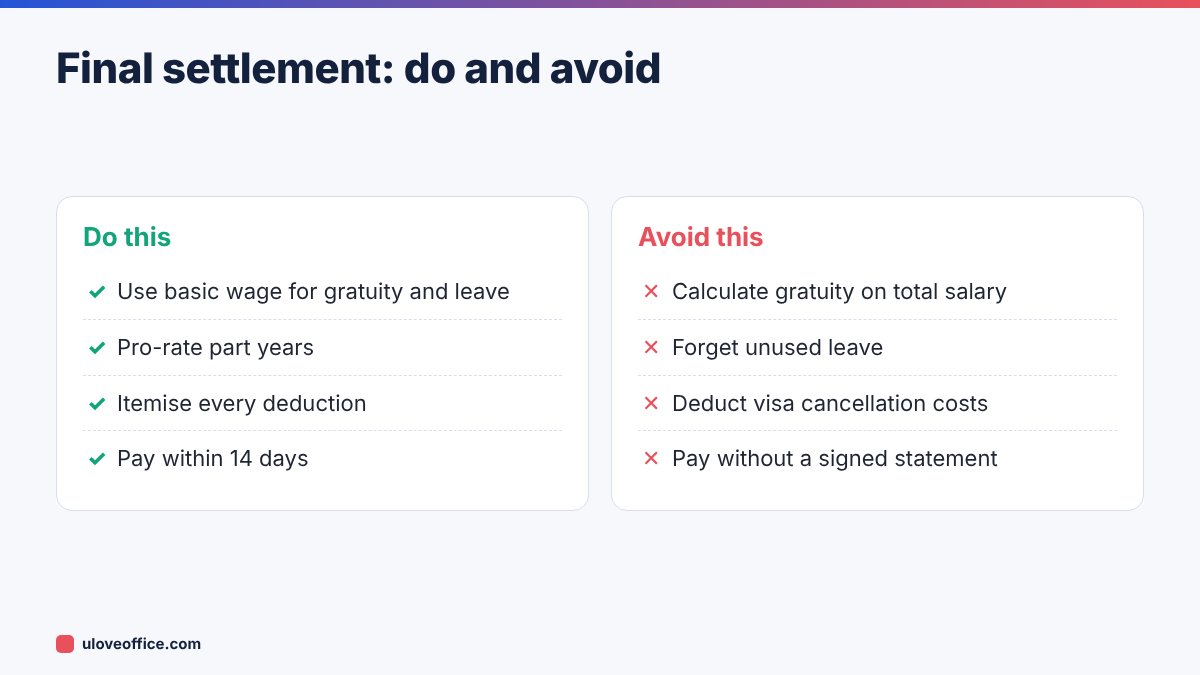
- Use total wage for unpaid salary days and notice pay, and basic wage for gratuity and unused leave.
- Gratuity is 21 days per year for the first five years and 30 days per year after, capped at two years’ wage.
- Pro-rate part years once the first full year is complete, and exclude unpaid absences.
- Itemise every deduction and only deduct what the law allows.
- Pay everything within 14 days and keep a signed settlement statement.
How to pay and document it
- Prepare a final settlement statement listing every component and deduction.
- Have the employee review and sign it, keeping a copy for both sides.
- Pay through the usual salary channel (WPS) or bank transfer, within 14 days.
- Complete visa and work permit cancellation through MOHRE and the relevant authority.
- Issue an experience certificate if requested.
Save the signed statement as a PDF and protect it with our Protect PDF tool before emailing it, because it contains personal salary data.
📘 Continue reading
Frequently asked questions
Is gratuity paid if an employee resigns in the first year?
No. Gratuity requires at least one year of continuous service.
Is gratuity calculated on basic or total salary?
On the last basic wage, unless the contract gives a more generous basis.
Does an employee terminated for gross misconduct lose gratuity?
Under the 2021 law, dismissal without notice for specific serious reasons does not automatically remove gratuity, but other consequences can apply. Take legal advice in misconduct cases.
What if the employer pays late?
Delays can lead to a complaint to MOHRE. Pay within 14 days to avoid disputes.
Conclusion
A correct UAE final settlement comes down to using the right salary for each part: total wage for salary days and notice pay, basic wage for gratuity and unused leave. Add the repatriation ticket and any other contractual dues, subtract only lawful deductions, document everything and pay within 14 days. Run your numbers through the gratuity calculator as a cross-check before you sign.
This guide is general information, not legal advice. Last checked: 9 November 2026. Confirm with MOHRE or a UAE employment lawyer for specific cases.