
UAE e-invoicing 2027: who is in scope, deadlines and preparation checklist
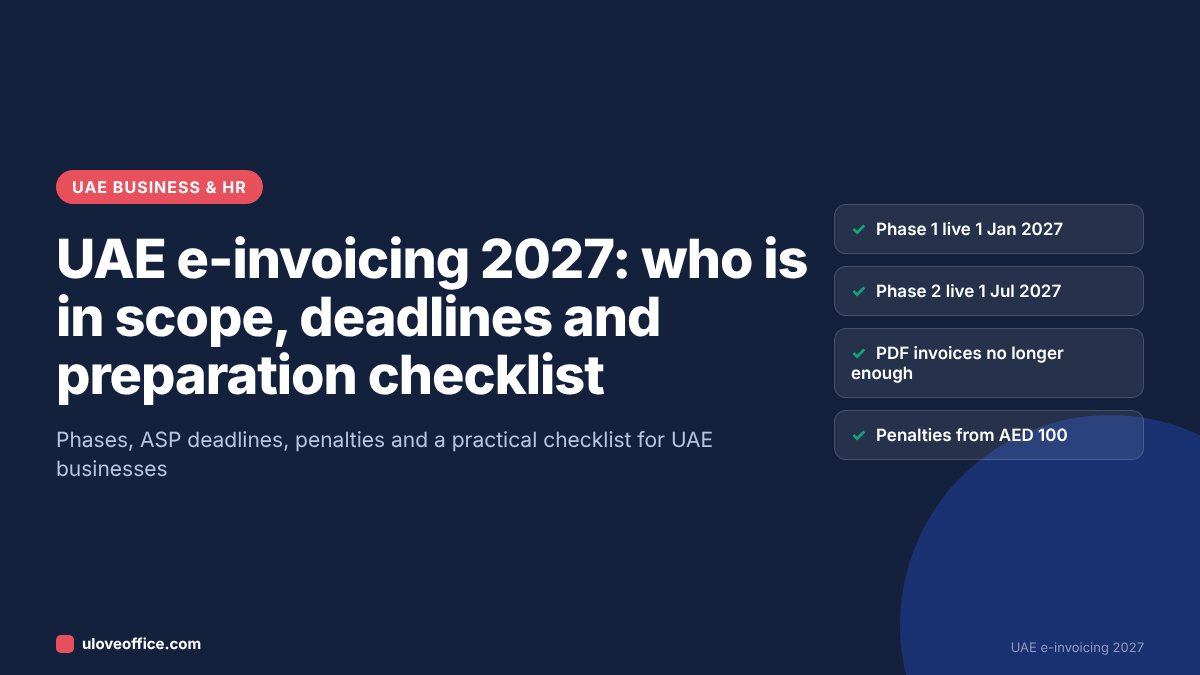
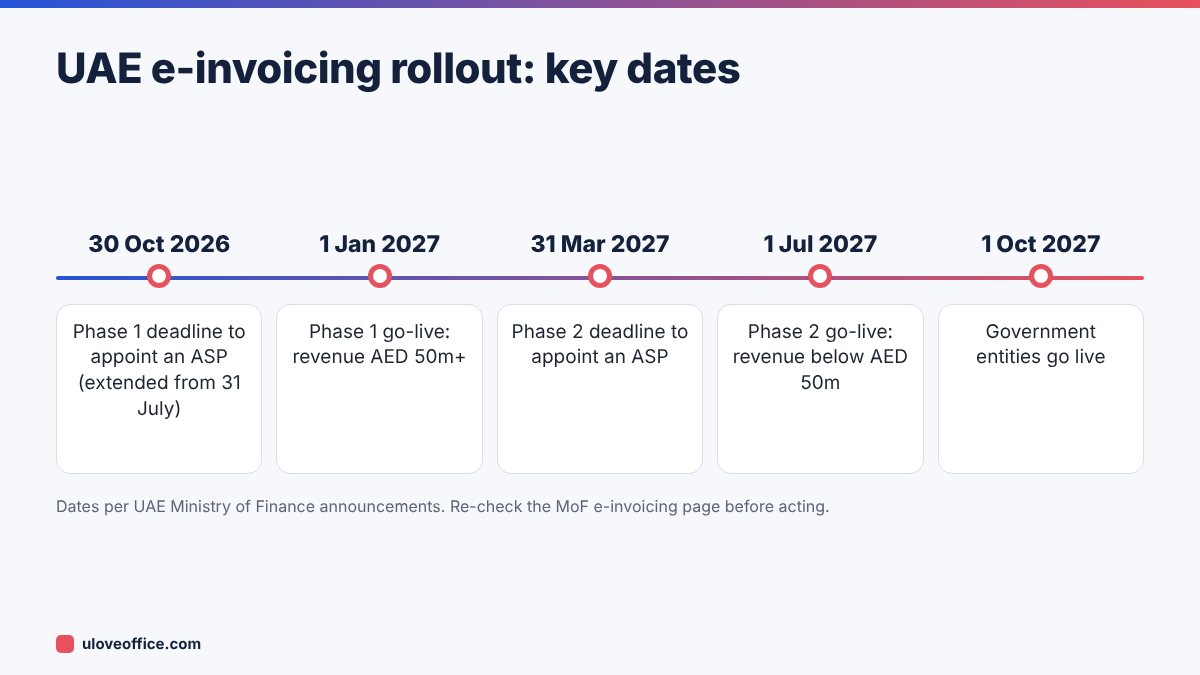
Quick answer: Mandatory e-invoicing in the UAE starts on 1 January 2027 for businesses with annual revenue of AED 50 million or more. Businesses below that threshold must appoint an Accredited Service Provider (ASP) by 31 March 2027 and start issuing e-invoices on 1 July 2027. Government entities follow on 1 October 2027. From those dates, a PDF or paper invoice is no longer a valid invoice for in-scope transactions. Invoices must be created as structured XML and sent through an accredited provider.
If you run a business in the UAE, this is the biggest change to invoicing since VAT arrived in 2018. This guide explains who is covered, the deadlines that apply to you, what the penalties are and what to do in the next few months.
What UAE e-invoicing actually means
E-invoicing is not the same as emailing a PDF. Under the UAE system, an invoice is a structured data file (XML) built to a national standard called PINT AE, which is the UAE version of the international Peppol format. Every field, from your Tax Registration Number (TRN) to the VAT amount on each line, sits in a defined place in the file, so software can read it without anyone retyping it.
The system uses what the Ministry of Finance calls a decentralised continuous transaction control and exchange model (DCTCE). In plain terms:
- You do not send the invoice straight to your customer. You send it to your Accredited Service Provider, a company approved by the Ministry of Finance.
- Your ASP checks the file, then passes it to your customer’s ASP, which delivers it to your customer.
- At the same time, the tax data from the invoice is reported to the Federal Tax Authority (FTA).
This is often called the five-corner model: supplier, supplier’s ASP, buyer’s ASP, buyer, and the FTA as the fifth corner. We explain it step by step in our guide to Peppol e-invoicing in the UAE.
Who is in scope
The mandate covers business-to-business (B2B) and business-to-government (B2G) transactions carried out by businesses in the UAE. It applies whether or not you are registered for VAT, unless the law specifically excludes you. A free zone company that sells to other businesses is in scope just like a mainland company.
Business-to-consumer (B2C) sales to individual customers are excluded until further notice. A retail shop selling to walk-in customers does not need to e-invoice those sales yet. If the same shop also invoices corporate clients, those invoices are in scope.
Which phase you fall into depends on your annual revenue:
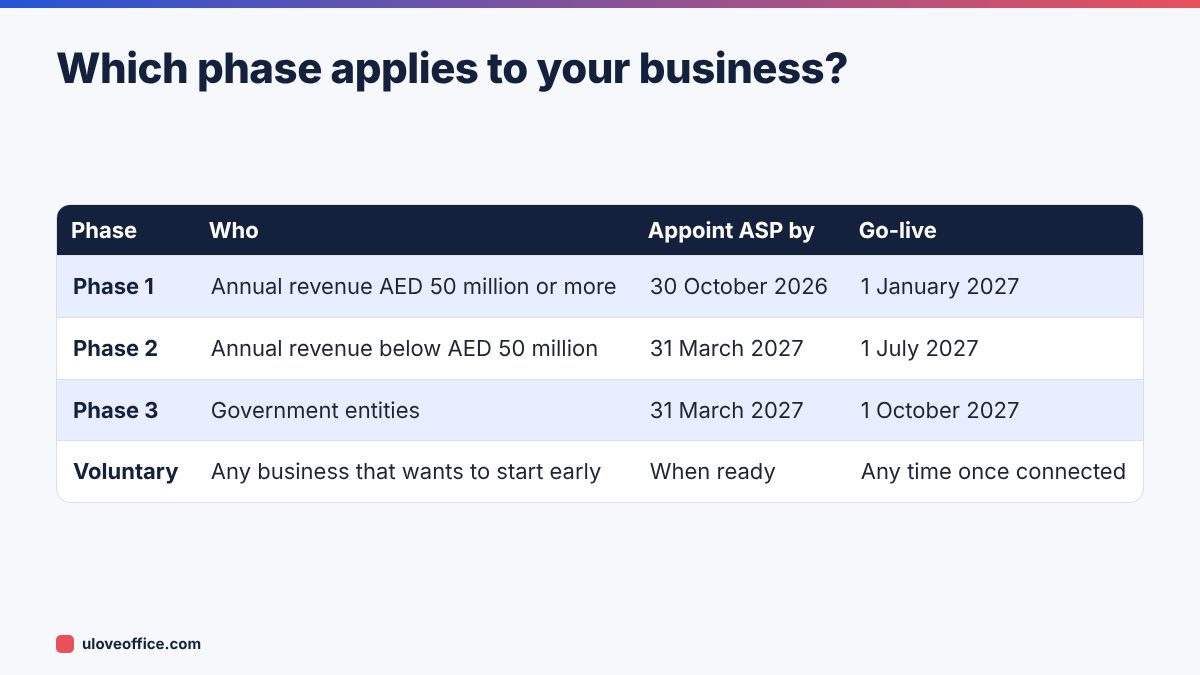
If you are not sure which revenue figure to use, ask your tax adviser to confirm it against the Ministerial Decision. Groups with several legal entities should check each entity separately.
The deadlines that matter right now
As of November 2026, the situation looks like this:
- Phase 1 businesses should already have appointed an ASP. The original deadline of 31 July 2026 was extended to 30 October 2026, and that date has passed. If you are a Phase 1 business without an ASP, every month of delay can attract a penalty, so act this week.
- Phase 2 businesses, which covers most SMEs, have until 31 March 2027 to appoint an ASP. That sounds far away, but connecting your accounting software, cleaning your customer data and testing takes time. Start selecting a provider now.
- All businesses that receive invoices from Phase 1 suppliers should expect electronic invoices from January 2027. Your accounts payable team needs a way to receive them, which also means an ASP.
What happens to PDF invoices?
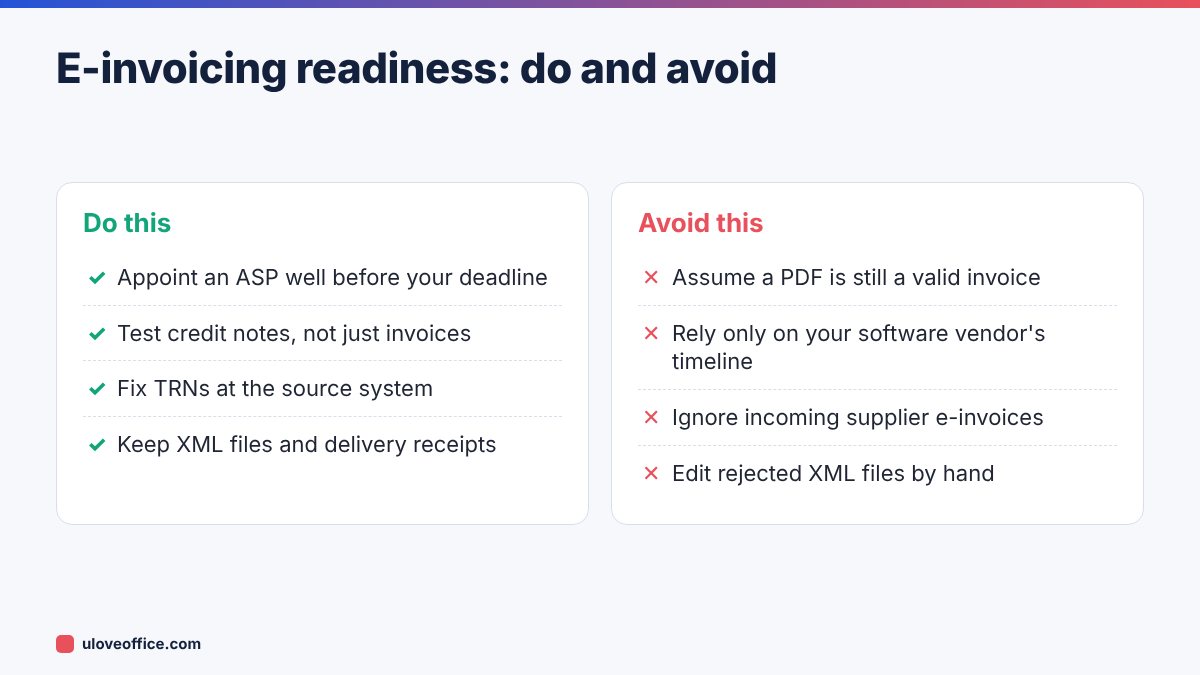
This is the question we hear most. For in-scope transactions, a PDF, a scanned image or a Word file does not meet the requirements of the e-invoicing system. The legal invoice is the structured XML file exchanged through the ASPs.
You can still send a PDF copy to a customer as a courtesy, for example so they can see your logo and payment details. But the PDF is not the invoice. We cover this in detail in our article on whether you can still send PDF invoices in the UAE.
Penalties for non-compliance
Cabinet Decision No. 106 of 2025 sets the administrative penalties. The main ones are:
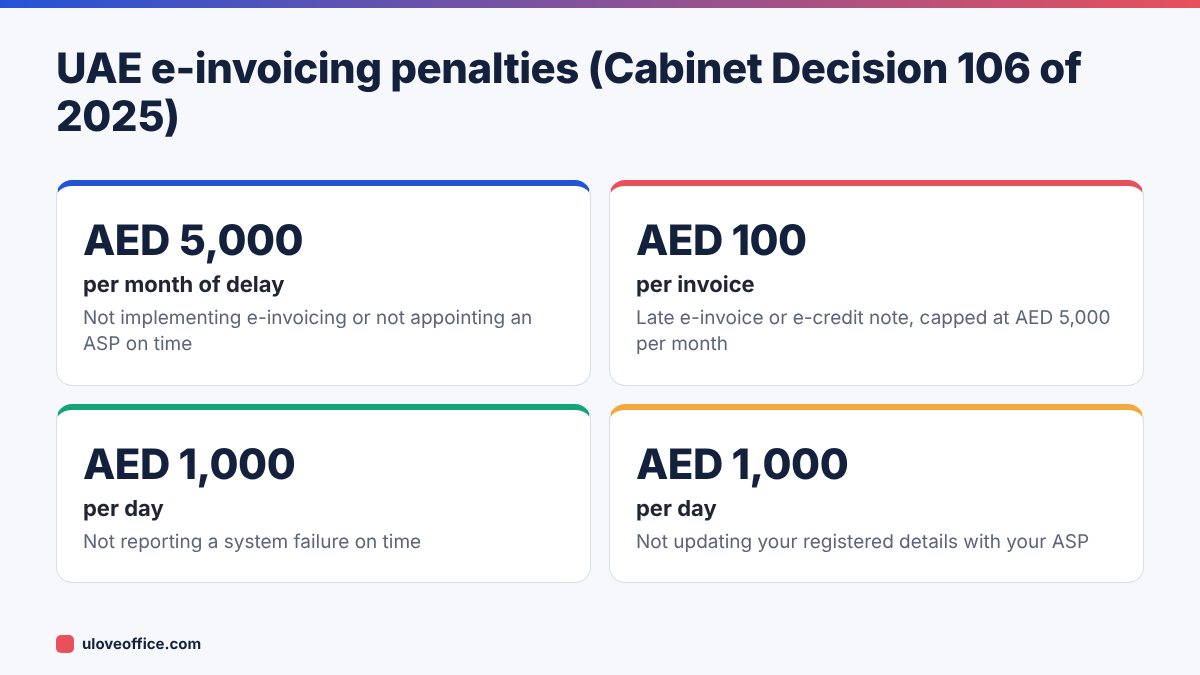
The numbers look small next to some VAT penalties, but they add up. A business that misses go-live by six months is looking at AED 30,000 in delay penalties alone, before any late-invoice fines.
What changes inside your business
E-invoicing touches more than your finance team. Expect changes in these areas:
- Accounting or ERP system. Your software must produce PINT AE XML or connect to an ASP that converts your data. Many cloud accounting tools are building this in. Older desktop software may need an upgrade.
- Customer master data. Every B2B customer needs a correct legal name, TRN and electronic address (Peppol ID). Typos that never mattered on a PDF will now cause rejections.
- Invoice numbering and types. Credit notes, self-billing and special cases such as free zone or margin scheme supplies must carry the correct transaction flags.
- Accounts payable. Supplier invoices will arrive as data, not email attachments. This is a chance to automate matching against purchase orders.
- Record keeping. Keep the XML files and your ASP’s delivery confirmations, not just PDFs.

Step-by-step preparation checklist
Use this order. Each step depends on the one before.
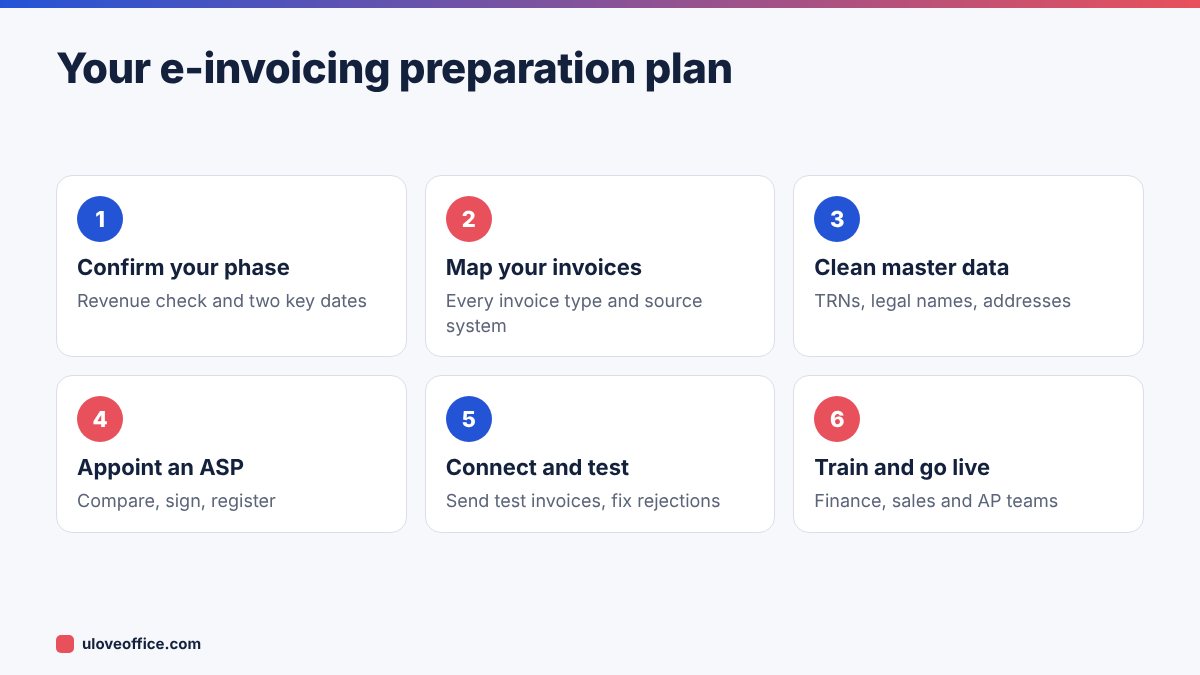
1. Confirm your phase
Check your annual revenue figure with your accountant and write down your two dates: ASP appointment and go-live. Put them in your company calendar with reminders 90, 60 and 30 days before.
2. Map every invoice you issue
List every type of document you send: standard tax invoices, simplified invoices, credit notes, pro-forma invoices, self-billed invoices and invoices from free zone entities. Note which system creates each one. Many businesses discover that one department still makes invoices in Excel or Word. Those will have to move into a system.
3. Clean your customer data
Export your customer list and check every B2B record for legal name, TRN (15 digits), address with emirate, and contact for e-invoice delivery. The ASP will reject invoices with invalid identifiers.
4. Choose an Accredited Service Provider
Only providers accredited by the Ministry of Finance can connect you. Compare them on integration with your accounting software, pricing (per invoice or flat fee), support hours, Arabic support and archiving. Our guide on how to choose a UAE e-invoicing ASP has a comparison checklist.
5. Connect your system and test
Your ASP will help you connect your accounting system through an API, a plug-in or a file upload. Send test invoices for every invoice type you mapped in step 2, including credit notes. Track every rejection and its reason, and fix the source data rather than editing files by hand.
6. Update your invoice template and contracts
Review the 51 mandatory fields for tax invoices (see our article on UAE e-invoice mandatory fields) and make sure your system captures each one. Update customer contracts and purchase terms that refer to “invoices sent by email”. Until your go-live date, our free UAE invoice format template still covers the VAT invoice layout you need.
7. Train your teams
Sales staff need to collect correct customer data at onboarding. Finance needs to know how to handle rejections and credit notes. Accounts payable needs to know where incoming e-invoices arrive.
8. Set up monitoring after go-live
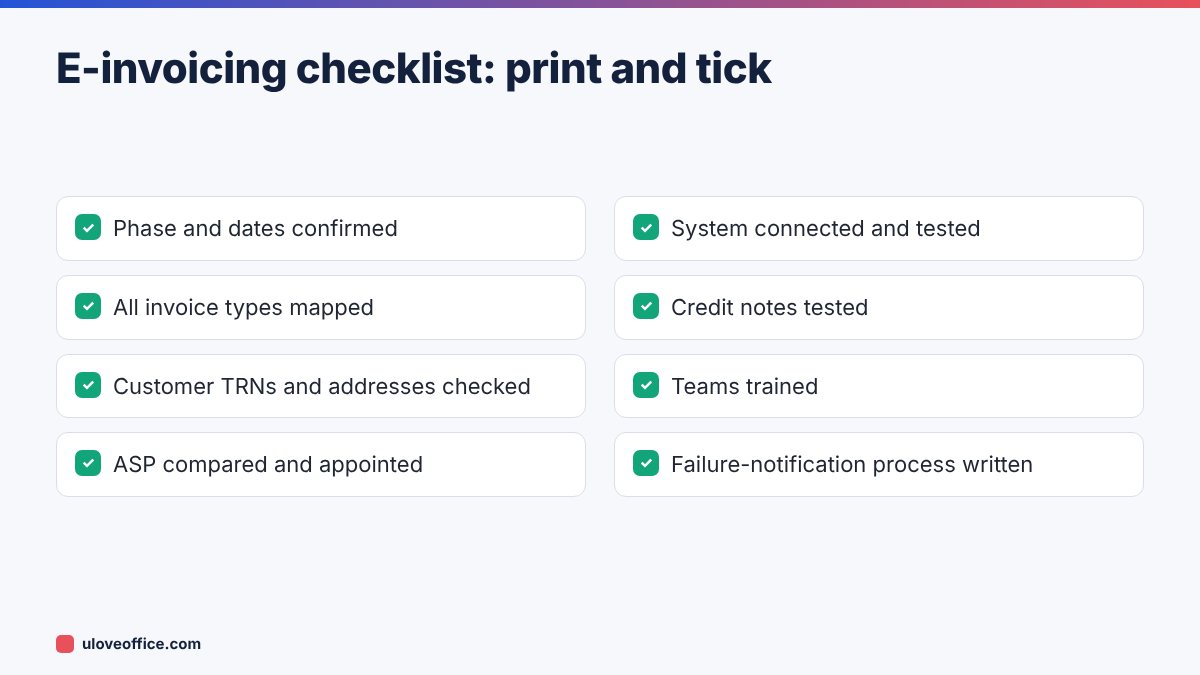
Review rejected and late invoices weekly for the first three months. Remember the system-failure rule: if your system or ASP goes down, you must notify the authority within the required time to avoid daily penalties.
Common mistakes to avoid
- Waiting for the accounting software vendor. Ask your vendor now, in writing, when PINT AE output will be ready. If they cannot give a date, plan a workaround through your ASP.
- Treating it as an IT project only. Most rejections come from bad data entered by people, not from software bugs.
- Forgetting incoming invoices. You need an ASP to receive e-invoices from Phase 1 suppliers even if you are a Phase 2 business.
- Deleting old records. Your existing PDF invoices and VAT records must still be kept for the legal retention period.
How ULoveOffice tools can help during the transition
E-invoicing replaces the invoice itself, but plenty of paperwork around it stays in PDF. Use our free tools for the jobs that remain:
- Check VAT amounts on quotes and pro-forma invoices with the UAE VAT Calculator.
- Turn old supplier PDF invoices into a spreadsheet for data clean-up with PDF to Excel.
- Make scanned historical invoices searchable with OCR PDF before archiving.
- Convert records to an archive-friendly format with PDF to PDF/A.
📘 Continue reading: UAE e-invoicing series
Frequently asked questions
Does e-invoicing apply to businesses that are not VAT registered?
Yes. The mandate applies to businesses in the UAE whether or not they are VAT registered, unless a specific exclusion applies. Check the Ministerial Decisions or ask your adviser.
Do I need e-invoicing for sales to consumers?
Not yet. B2C transactions are excluded until further notice.
Can my accountant just upload PDFs to a portal?
No. The system needs structured XML that meets the PINT AE standard, sent through an accredited provider.
What if my ASP goes down on an invoicing day?
You must notify the authority about the system failure within the required time. Ask your ASP how they handle outages and notifications.
Where can I find the official rules?
On the UAE Ministry of Finance e-invoicing page, which publishes the Ministerial Decisions, the mandatory field list and the list of accredited providers.
Conclusion
UAE e-invoicing is no longer a future project. Phase 1 businesses go live on 1 January 2027 and most SMEs follow on 1 July 2027, with an ASP deadline of 31 March 2027. Confirm your phase, clean your customer data, appoint a provider and start testing early. The businesses that prepare now will also get faster payments and less manual data entry.
Last checked: 9 November 2026. Rules and dates can change. Always confirm with the UAE Ministry of Finance, the FTA or a registered tax adviser before making decisions.