
Can you still send PDF invoices in the UAE after e-invoicing starts?
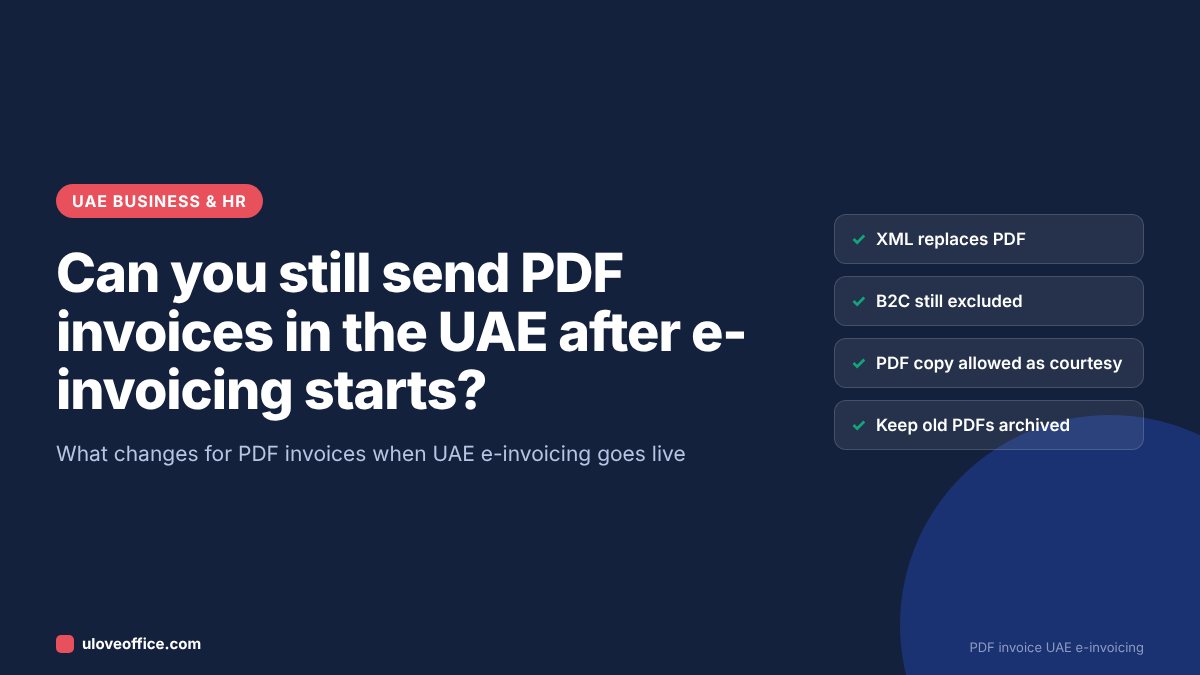
Quick answer: For business-to-business and business-to-government sales that fall under the UAE e-invoicing mandate, a PDF is no longer a valid invoice once your go-live date arrives (1 January 2027 for businesses with revenue of AED 50 million or more, 1 July 2027 for everyone else). The legal invoice becomes a structured XML file sent through an Accredited Service Provider. You can still email a PDF copy for your customer’s convenience, but it has no legal standing as the tax invoice. Sales to individual consumers are excluded from the mandate for now, so PDF and paper invoices remain acceptable there.
For many small businesses in Dubai, Sharjah and Abu Dhabi, invoicing has meant one thing for years: fill in a Word or Excel template, export it to PDF and email it. That habit has to change. This article explains exactly what changes, what stays the same, and how to move from PDF invoicing without disrupting cash flow.
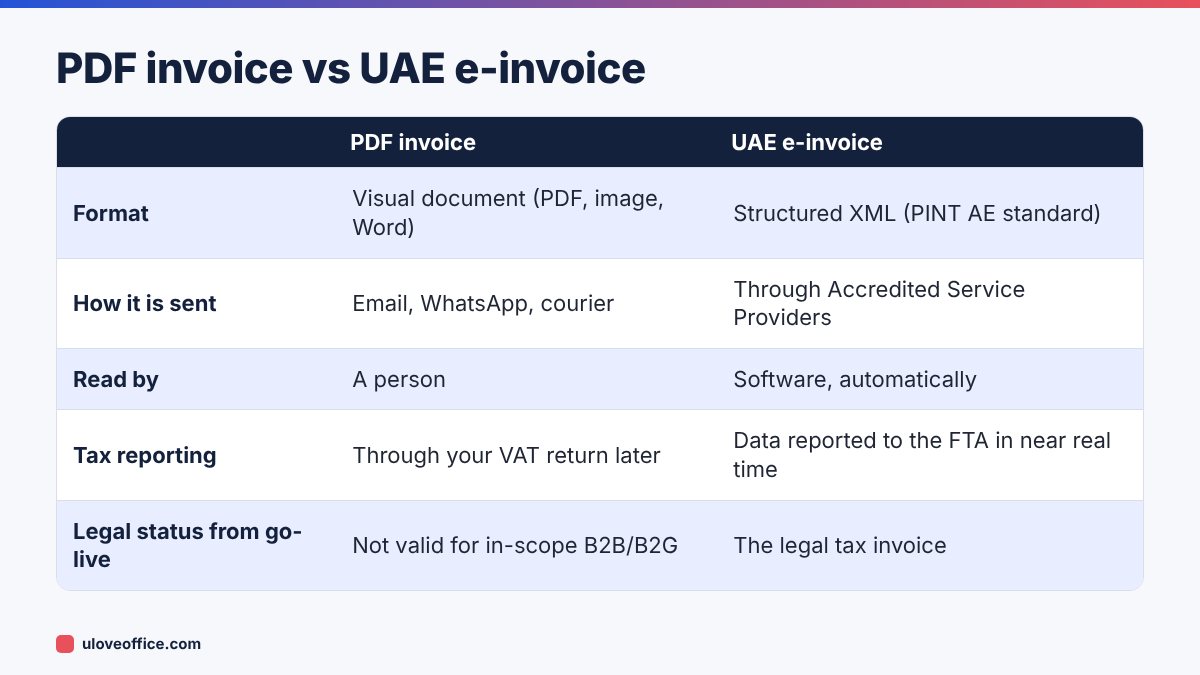
Why a PDF is not an e-invoice
A PDF looks like an invoice to a human, but to software it is mostly a picture. A computer has to guess where the invoice number, TRN and VAT total are, which is why OCR tools and data-entry staff exist.
The UAE e-invoicing system is built on structured data. Each piece of information is tagged in an XML file according to the PINT AE specification, the UAE’s version of the Peppol international standard. The receiving system knows exactly which tag holds the seller’s TRN, which holds the VAT rate on line 3, and which holds the total payable. The Ministry of Finance guidance is explicit that unstructured formats, including PDF and image-based invoices, do not meet the system’s requirements.
The XML file also passes through a validation step at your Accredited Service Provider (ASP). If a mandatory field is missing or a TRN is in the wrong format, the invoice is rejected before it ever reaches your customer. A PDF cannot be validated this way.
Which invoices are affected
From your go-live date, the rule applies to transactions in scope of the mandate:
- B2B sales: invoices to other businesses in the UAE, including free zone companies.
- B2G sales: invoices to government entities.
- Credit notes linked to those sales, which must also be electronic.
And it does not apply, for now, to:
- B2C sales to individual consumers, which are excluded until further notice.
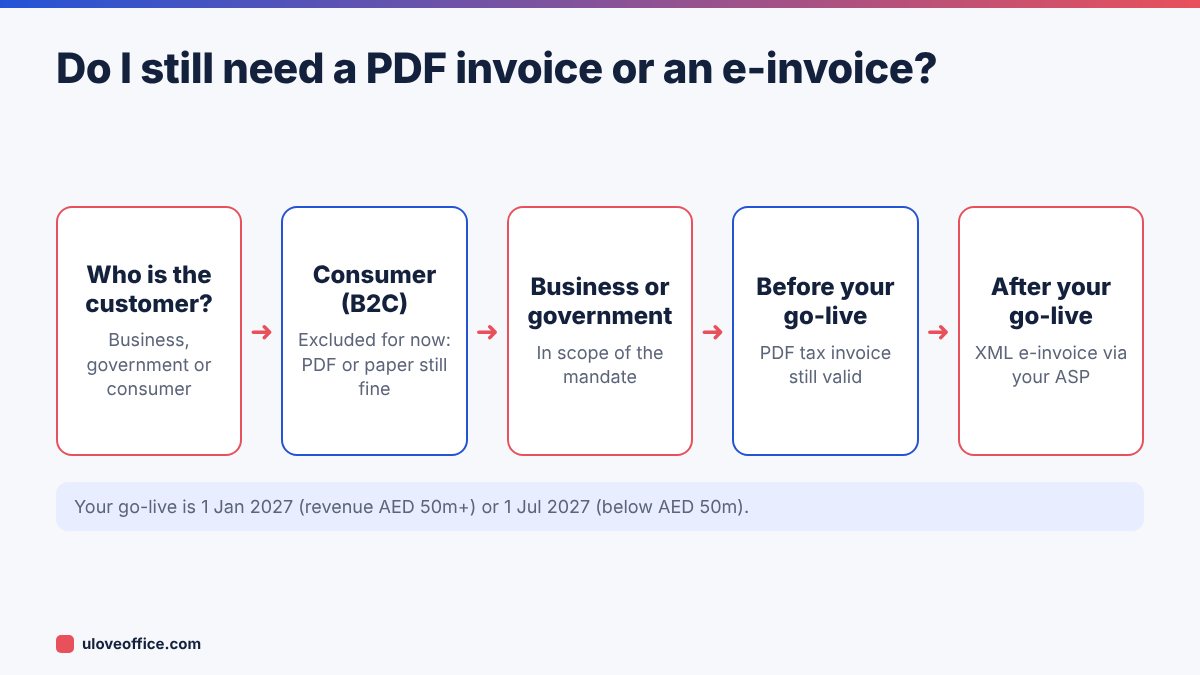
Before your go-live date, nothing changes. A properly formatted PDF tax invoice that meets the VAT rules is still valid. If you are a Phase 2 business (revenue below AED 50 million), you can keep using PDF invoices until 30 June 2027, as long as you appoint your ASP by 31 March 2027 and are ready on 1 July.
Can I still email a PDF copy?
Yes. Nothing stops you sending a nicely designed PDF version of the invoice alongside the e-invoice. Many customers will want one for the first months while their own teams adjust. Some ASPs and accounting tools generate a PDF “visualisation” of the XML automatically.
Two rules keep you out of trouble:
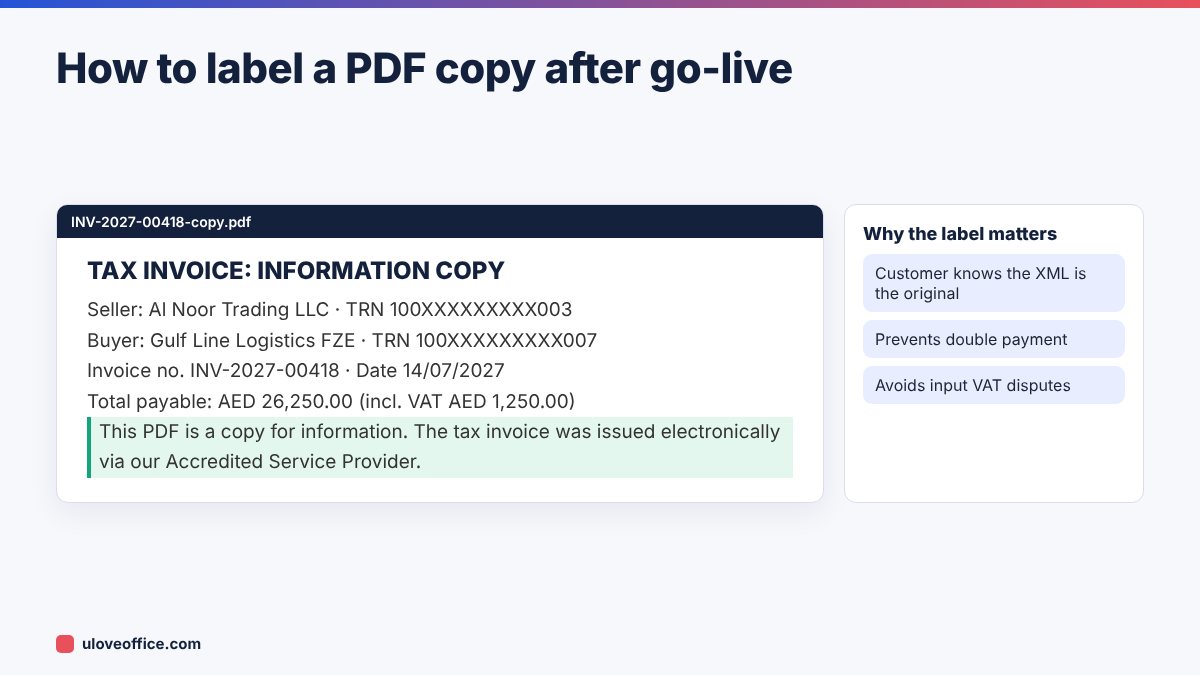
- The XML e-invoice is the original. If the PDF and the XML ever differ, the XML is what counts for tax. Generate the PDF from the same data, never by retyping.
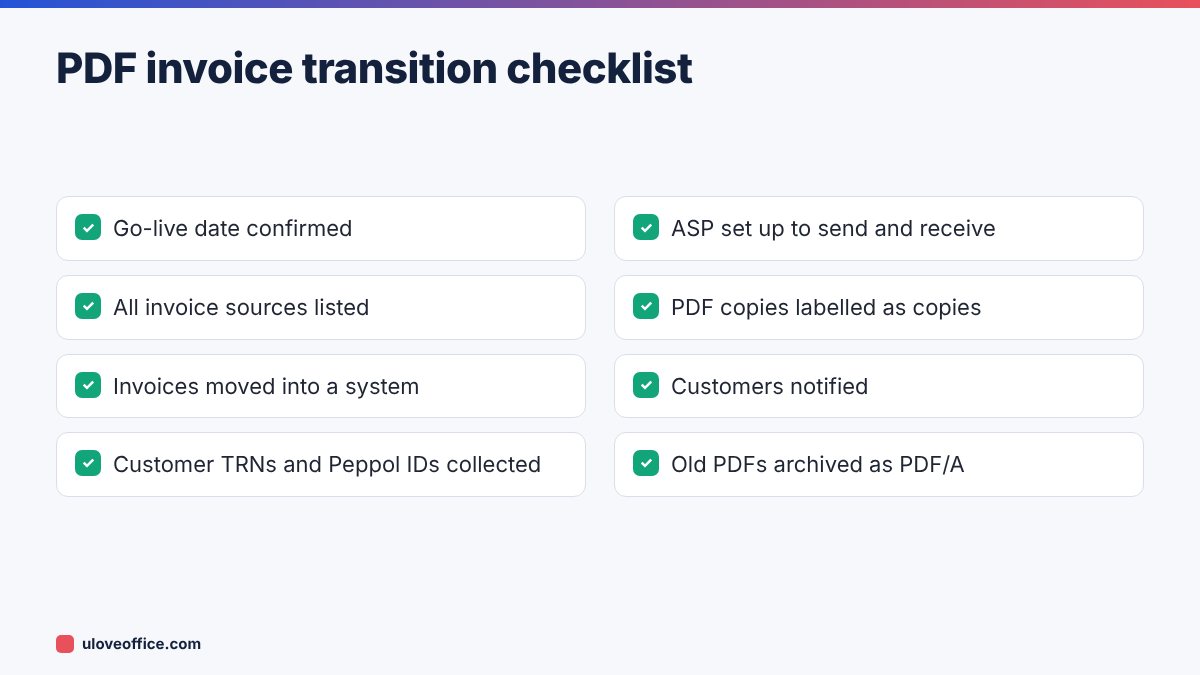
- Label the PDF clearly. Add a line such as “This is a copy for information. The tax invoice has been issued electronically.” That stops a customer from paying from an outdated PDF or treating it as the tax document for input VAT.
What about invoices I receive as PDFs?
From January 2027, Phase 1 suppliers will start sending you e-invoices. If you receive a PDF from a supplier who is in scope and past their go-live, that PDF is not a valid tax invoice. That matters because you need a valid tax invoice to recover input VAT.
Practical steps for accounts payable:
- Make sure you have an ASP set up to receive e-invoices, even if your own go-live is later.
- Ask key suppliers for their go-live dates and electronic addresses (Peppol IDs).
- If an in-scope supplier keeps sending PDFs after their go-live, ask them to issue the invoice electronically before you claim the VAT.
What happens to my old PDF invoices?
They stay valid for the period they were issued in, and you must still keep them. VAT and corporate tax rules require records to be kept for several years (generally at least five years for VAT and seven years for corporate tax purposes; check current FTA guidance for your situation).
Good archiving habits now will save time later:
- Make scanned invoices searchable with OCR PDF so you can find any invoice by number or TRN.
- Combine monthly invoice batches into one file per month with Merge PDF.
- Convert the final archive to PDF/A, a format designed for long-term storage.
How to move from PDF invoicing: a practical plan
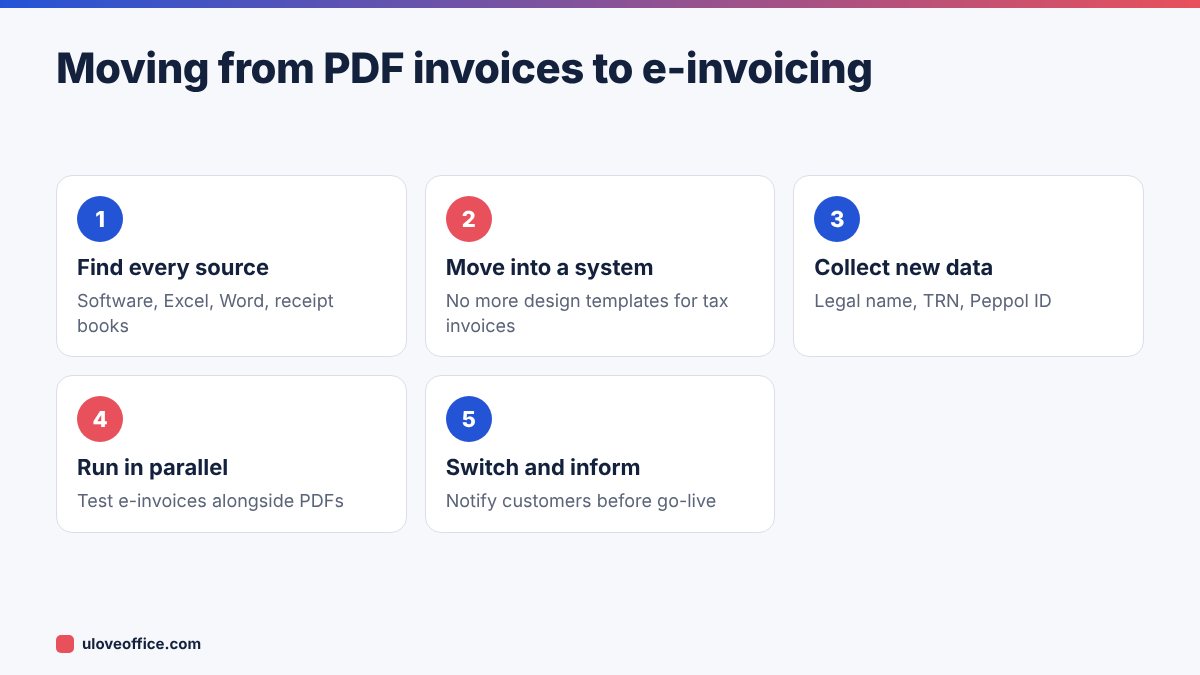
Step 1: Find every PDF invoice source
List every place an invoice is made today. A typical SME has three or four: the accounting system, a sales person’s Excel template, a Word template for service jobs, and a manual receipt book for cash sales. Each one either moves into your e-invoicing-ready system or is stopped.
Step 2: Move templates into a system
E-invoices must be generated from structured data. That means your invoices need to come from accounting software or a system connected to your ASP, not from a design template. If your team loves your current PDF layout, keep it as the visual copy produced by the system.
Step 3: Collect customer details you never needed before
For each B2B customer you now need their exact legal name, TRN and electronic address. Add these fields to your customer onboarding form. Our free tool Fill PDF Forms is handy if customers still send back PDF registration forms.
Step 4: Run both in parallel before go-live
For a few weeks before your date, issue the e-invoice through your ASP in test mode while still sending the PDF tax invoice. Compare totals and fix differences.
Step 5: Switch and communicate
On go-live, stop sending PDF tax invoices to in-scope customers. Email customers a short notice in advance explaining that invoices will arrive electronically and that any PDF is a copy only. Include your own electronic address, the date of the change and a contact person in your finance team. Send the notice at least a month before go-live, and repeat it with the first e-invoice, because the person who reads your email is often not the person who processes invoices.
Common misunderstandings
“My accountant will convert my PDFs to XML.” Converting PDFs after the fact is not how the system works. The invoice must be created and transmitted electronically within the required time.
“Signing the PDF digitally makes it compliant.” A digital signature proves who sent a document. It does not turn a PDF into structured PINT AE data.
“Small businesses are exempt.” There is no small business exemption based on size alone. Smaller businesses simply have a later date (1 July 2027).
“We only invoice free zone companies, so it does not apply.” Free zone B2B transactions are within the scope of the guidance, which includes specific free zone transaction flags.
What to update on your website and documents
If your business publishes invoice templates, quotation formats or payment instructions online, update them. Add a note that from your go-live date, tax invoices are issued electronically. Our own UAE invoice format template remains useful for consumer sales and for businesses before their go-live date, and for quotations and pro-forma invoices, which are not tax invoices.
Key takeaways
- From your go-live date, the XML e-invoice is the legal invoice for in-scope B2B and B2G sales; a PDF is only a copy.
- B2C sales are excluded for now, so PDF and paper invoices remain fine for consumers.
- Label any PDF copy clearly and generate it from the same data as the e-invoice.
- Make sure you can receive e-invoices from suppliers, even if your own go-live is later.
- Keep archiving old PDF invoices for the full retention period.
📘 Continue reading
Frequently asked questions
Is a PDF invoice still valid for B2C customers in 2027?
Yes. B2C transactions are excluded from the e-invoicing mandate until further notice, so normal VAT invoicing rules continue to apply.
Can I attach a PDF to the e-invoice?
Many systems allow attachments such as delivery notes or timesheets. The tax data must still be in the XML.
Do quotations and pro-forma invoices need to be electronic?
They are not tax invoices, so they are not the focus of the mandate. Keep sending them as PDFs if you like, but label pro-formas clearly.
What if my customer insists on a stamped PDF?
Send the PDF copy with your stamp as a courtesy, and explain that the e-invoice is the legal original.
Conclusion
PDF invoices are not disappearing overnight, but their role is changing. For in-scope B2B and B2G sales, the PDF becomes a courtesy copy and the XML e-invoice becomes the real thing. Find every place your business still creates invoices by hand, move them into a system connected to an ASP, collect better customer data and run a short parallel test. Do that before your go-live date, and the switch will be routine.
Last checked: 9 November 2026. Confirm current requirements with the UAE Ministry of Finance or a registered tax adviser.