
UAE business record retention: corporate tax, VAT and e-invoice records
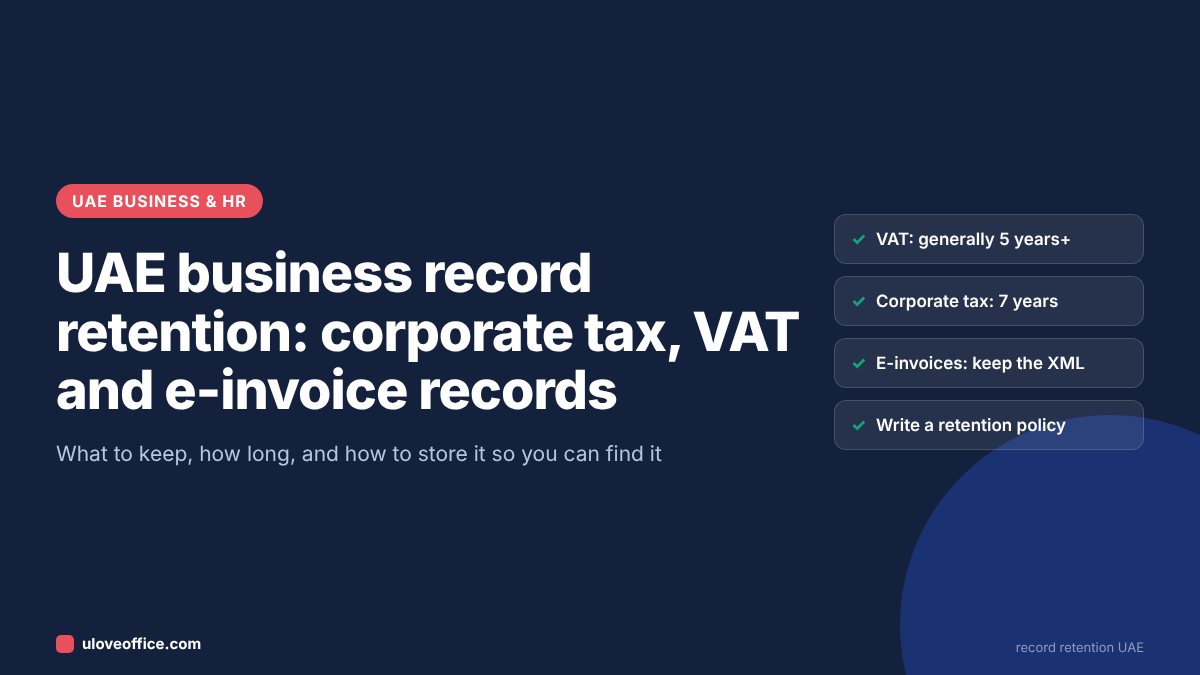
Quick answer: UAE businesses must keep accounting and tax records for set minimum periods. As a working guide: VAT records generally for at least five years after the end of the tax period they relate to (longer for some real estate records), and corporate tax records for seven years after the end of the relevant tax period. From 2027, keep e-invoices in their structured XML form along with delivery confirmations from your Accredited Service Provider. Contracts, HR and company records should be kept for as long as they may be needed for claims, audits or legal obligations. Always confirm current periods with the FTA or your tax adviser, as rules are updated.
Record keeping sounds boring until the FTA requests three years of invoices, a former employee files a claim or a bank asks for a contract signed in 2019. This guide explains what to keep, how long, and how to organise it so you can produce any document in minutes.
Why retention matters
- Tax audits: the Federal Tax Authority can review past periods and ask for supporting documents. Missing records can lead to penalties and to the FTA estimating your tax.
- Penalties for poor record keeping: UAE tax penalty rules include fines for failing to keep required records. The amounts can be significant and increase for repeat violations.
- Disputes: contracts, delivery notes and correspondence are your evidence in commercial disputes.
- Employment claims: signed contracts, payslips and leave records protect you in labour complaints.
- Banking and investors: lenders and buyers of your business will ask for historical records.
VAT records
Under UAE VAT law and the Tax Procedures Law, businesses must keep records that support their VAT returns, including:
- Tax invoices issued and received, and alternative documents.
- Credit notes and debit notes.
- Import and export documents, including customs declarations.
- Records of goods and services supplied, received, imported or exported.
- Records of goods disposed of or used for non-business purposes.
- Records of adjustments and corrections.
- The VAT account and working papers for each return.
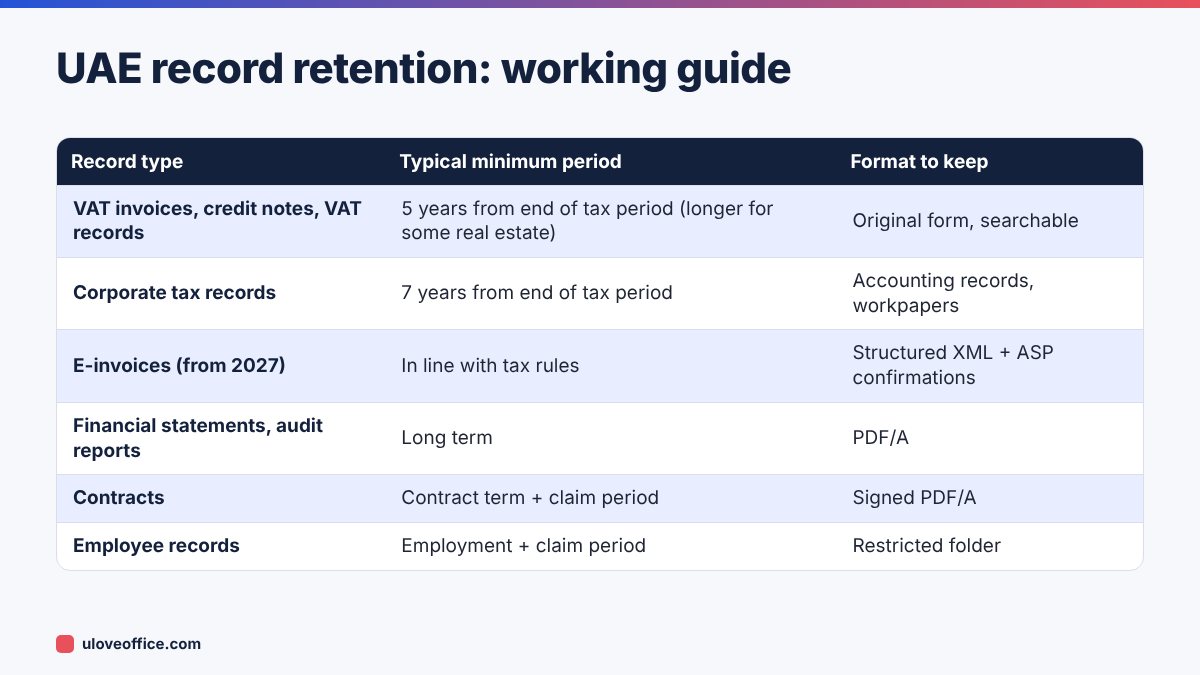
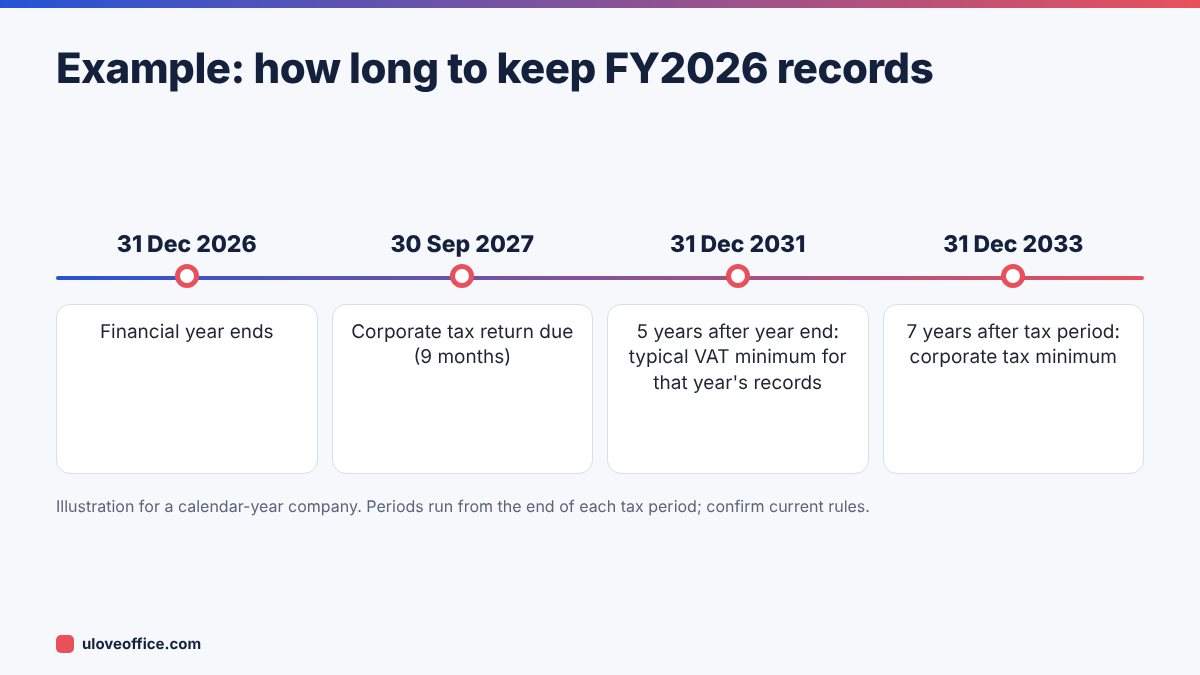
The general minimum is five years from the end of the tax period. For real estate, longer periods apply. If you are under audit or in a dispute, keep records until it is resolved even if the period has ended.
Corporate tax records
Under the UAE Corporate Tax Law, businesses must keep all records and documents needed to support the information in their tax returns for seven years after the end of the tax period they relate to. This includes:
- Accounting records and financial statements.
- Records supporting income, expenses and deductions.
- Transfer pricing documentation, where required.
- Records supporting any relief or exemption claimed, such as free zone qualifying income or small business relief.
- Records of transactions with related parties.
Because corporate tax applies from financial years starting on or after 1 June 2023, many businesses are now building their first seven-year archive. Set it up properly from the start.
E-invoice records from 2027
When UAE e-invoicing starts (1 January 2027 for businesses with revenue of AED 50 million or more, 1 July 2027 for others), the legal invoice becomes a structured XML file exchanged through Accredited Service Providers. For retention:
- Keep the XML files, not only PDF copies. The XML is the original record.
- Keep validation and delivery confirmations from your ASP, which show when the invoice was issued and accepted.
- Check your ASP’s archiving service: how long it stores invoices, in what format you can export them, and what happens if you change provider.
- Keep credit notes and their links to the original invoices.
Do not rely solely on your provider. Export your e-invoices regularly to your own storage.
Contracts and company documents
There is no single legal period for all contracts. A practical approach:
- Keep contracts for their whole term plus the period in which a claim could be made. Many businesses keep commercial contracts for at least ten years after expiry; agree a period with your legal adviser.
- Keep corporate documents, such as the memorandum of association, licences, shareholder resolutions and board minutes, for the life of the company.
- Keep property leases, including Ejari registrations, for the lease term plus a buffer.
Employee records
Keep employment contracts, offer letters, payslips or WPS records, leave records, warning letters and final settlement statements for the duration of employment plus a period after it ends to cover possible claims. Employment records also contain personal data, so the UAE Personal Data Protection Law applies: keep only what you need, restrict access and delete it securely when it is no longer needed.

In what format should you keep records?
UAE rules generally allow electronic records, as long as they are complete, accurate, accessible and can be produced when the FTA asks. Good practice:
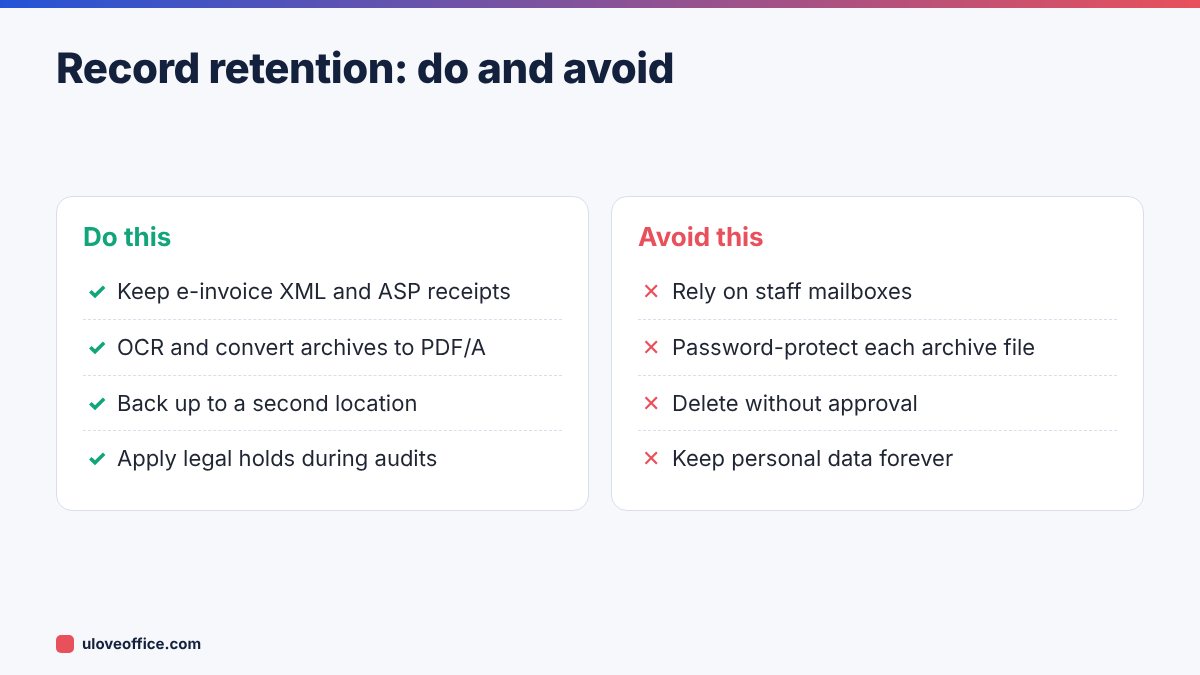
- Make scans searchable with OCR PDF, so you can find documents by invoice number or name.
- Use PDF/A for long-term storage with PDF to PDF/A. It embeds fonts and removes features that might stop the file opening in future. See our guide to what PDF/A is.
- Do not password-protect individual archive files. Passwords get lost. Protect the storage location instead.
- Keep records in English or Arabic. If records are in another language, the FTA may ask for a translation.
- Back up to at least one separate location.
Writing a simple retention policy
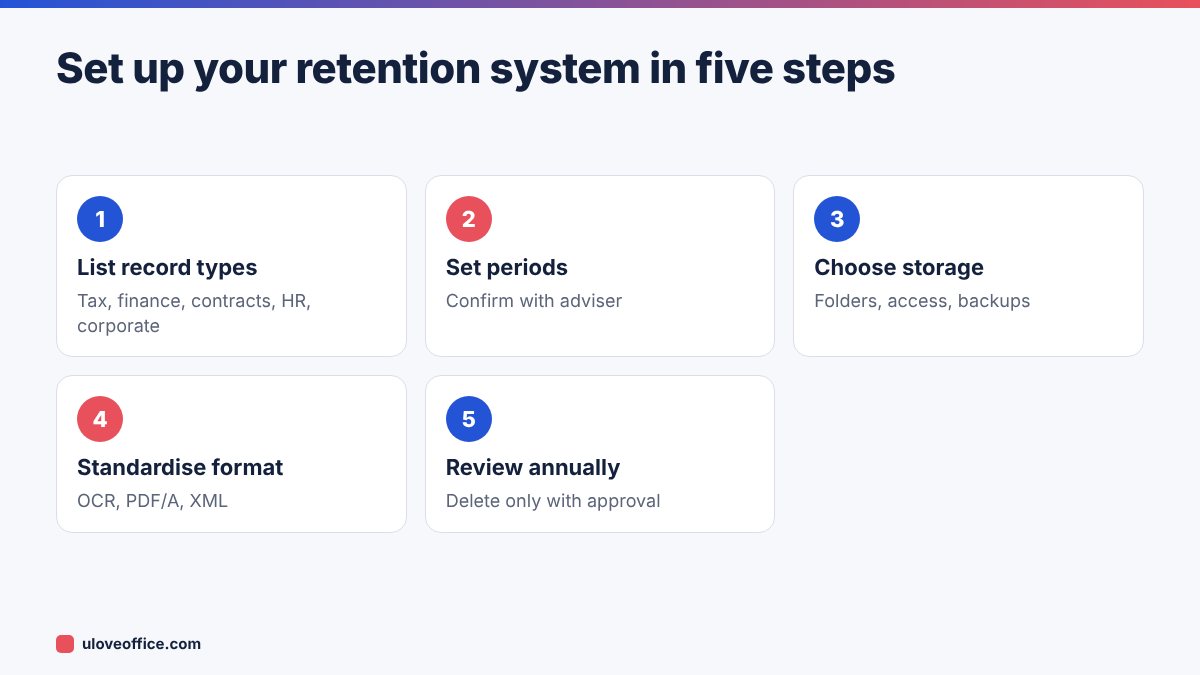
A one-page policy prevents both over-keeping and accidental deletion. It should include:
- Scope: which records it covers.
- Retention schedule: a table of record types and periods.
- Storage: where each type is kept and who has access.
- Format: electronic standards (searchable PDF, PDF/A, original XML).
- Review: who reviews records when the period ends, and how deletion is approved.
- Legal holds: records involved in audits, disputes or investigations are kept until the matter closes, regardless of the schedule.
- Secure deletion: how paper is shredded and electronic files are deleted.
A folder structure that works
Records/
  2026/
    01-Sales-invoices/
    02-Purchase-invoices/
    03-Bank-statements/
    04-VAT-returns/
    05-Payroll/
    06-Contracts-signed/
  2027/
    ...
  Permanent/
    Company-documents/
    Licences/
Merge each month’s documents into a few files with Merge PDF, such as 2026-11_Purchase-invoices.pdf, rather than keeping hundreds of loose files. Keep an index spreadsheet listing each folder, its contents, its retention end date and its backup location.
Common mistakes
- Keeping only PDFs of e-invoices and not the XML.
- Records in personal email accounts or on one employee’s laptop.
- Deleting records at year end without checking audits or disputes.
- Scans that cannot be read, such as blurry phone photos with no OCR.
- No backup, so one ransomware attack or failed drive loses years of records.
- Keeping everything forever, which increases data protection risk and makes searching harder.
Annual records review: a one-hour routine
Once a year, ideally after your financial year-end and tax filing, spend an hour on records:
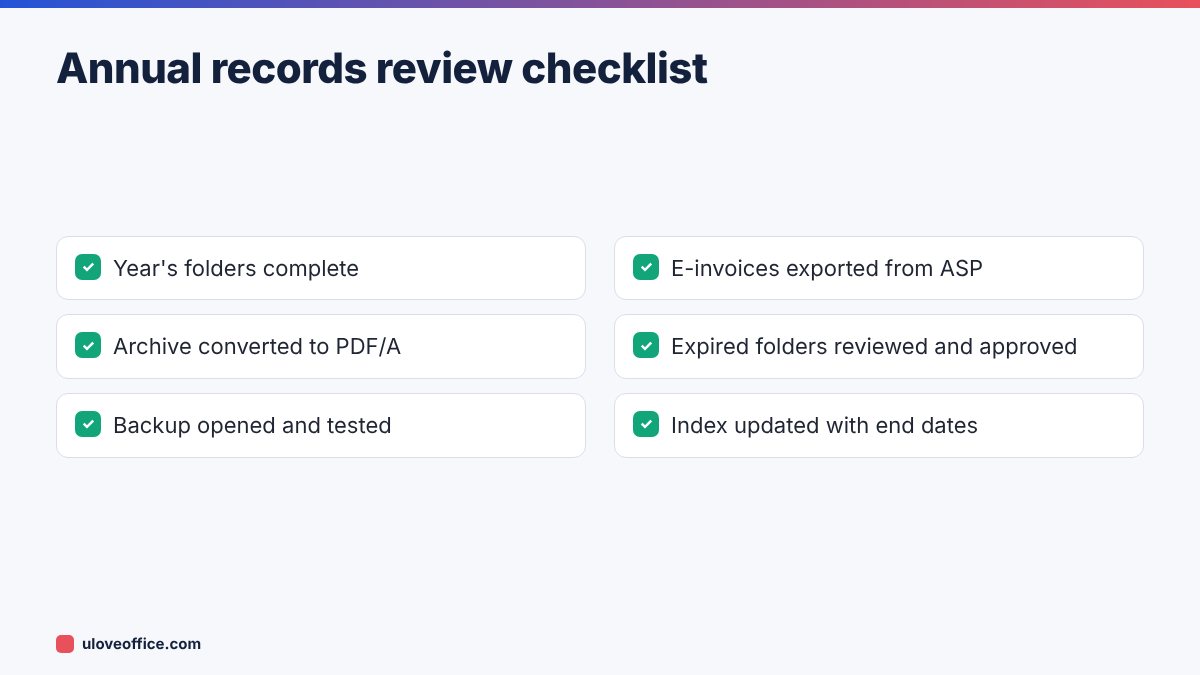
- Check this year’s folders are complete: twelve months of sales and purchase invoices, bank statements, VAT returns and payroll.
- Convert the year to PDF/A if you have not done so monthly.
- Verify the backup by opening a few files from the backup location, not just checking that it exists.
- Export e-invoices from your ASP for the year, including confirmations, and store them with the year.
- Review folders past their retention date. Confirm no audit, dispute or legal hold applies, get approval and delete securely.
- Update the index spreadsheet with retention end dates for the new year.
Put this routine in the finance calendar with a named owner. A records system decays without a regular review.
📘 Continue reading
Frequently asked questions
Can I keep only electronic copies of paper invoices?
Electronic records are generally acceptable if they are complete, legible and retrievable. Check FTA guidance for any document types where originals are required.
Do free zone companies have the same rules?
Free zone companies are subject to UAE VAT and corporate tax record-keeping rules, plus any requirements of their free zone authority.
What if my accountant keeps the records?
You remain responsible. Make sure you have copies or guaranteed access.
How long do I keep records after closing the company?
Retention obligations continue after deregistration. Ask your adviser before destroying anything.
If you only do one thing after reading this guide, write the retention schedule table and share it with your finance team and your accountant. Everything else builds on it.
Review the schedule whenever tax laws change; the FTA updates guidance regularly.
Key takeaways
- VAT records: generally at least five years; corporate tax records: seven years after the tax period.
- From 2027, keep e-invoices as XML with your ASP’s confirmations, not just PDFs.
- Store records electronically in a searchable, organised and backed-up way, using PDF/A for long-term archives.
- Apply legal holds during audits and disputes, whatever the schedule says.
- Write a one-page retention policy and review it yearly.
Conclusion
Know the minimums (generally five years for VAT records, seven years for corporate tax, the XML original for e-invoices) and build a simple system around them: one folder structure, searchable PDF/A archives, backups, a written policy and legal holds when needed. When the FTA or anyone else asks for a document, you will find it in minutes.
This article is general information, not tax advice. Last checked: 9 November 2026. Confirm current requirements with the FTA or a registered tax agent.