
Monthly business budget template for UAE SMEs
Quick answer: A useful monthly business budget for a UAE SME lists expected revenue and every cost by month for the year: rent and service charges, trade licence and permits, visas and medical insurance, salaries and benefits, utilities and telecoms, marketing, professional fees, loan repayments, and taxes (VAT payments and corporate tax). Spread annual costs, like the licence and visa renewals, across the months they fall due, or accrue them monthly so they never surprise you. Then track actual figures beside the budget every month and investigate big differences.
Many small business owners in the UAE run their business from the bank balance: if there is money, it is spent. That works until the annual licence renewal, three visa renewals and a quarterly rent cheque land in the same month. A budget turns those surprises into plans.
Budget vs cash flow forecast
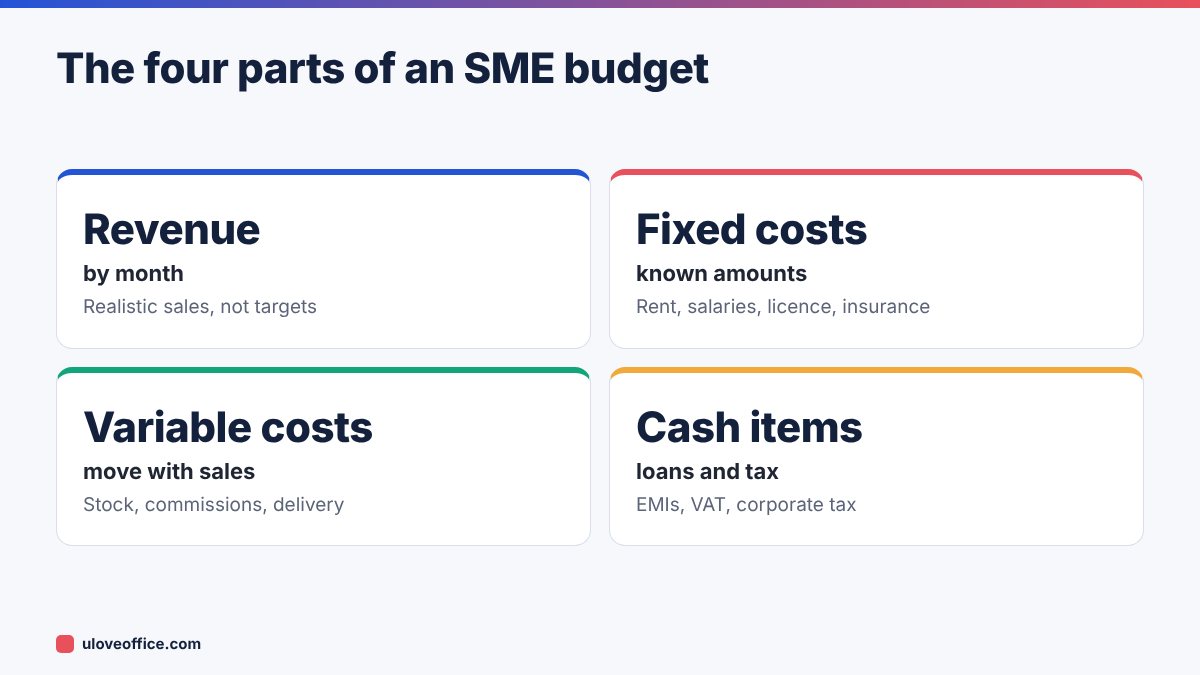
A budget is your plan for the year: what you expect to earn and spend each month. A cash flow forecast tracks when cash actually comes in and goes out, week by week. You need both. Build the budget first, then use it as the base for your 13-week cash flow forecast.
UAE-specific cost lines
Generic budget templates miss costs that matter here. Include:
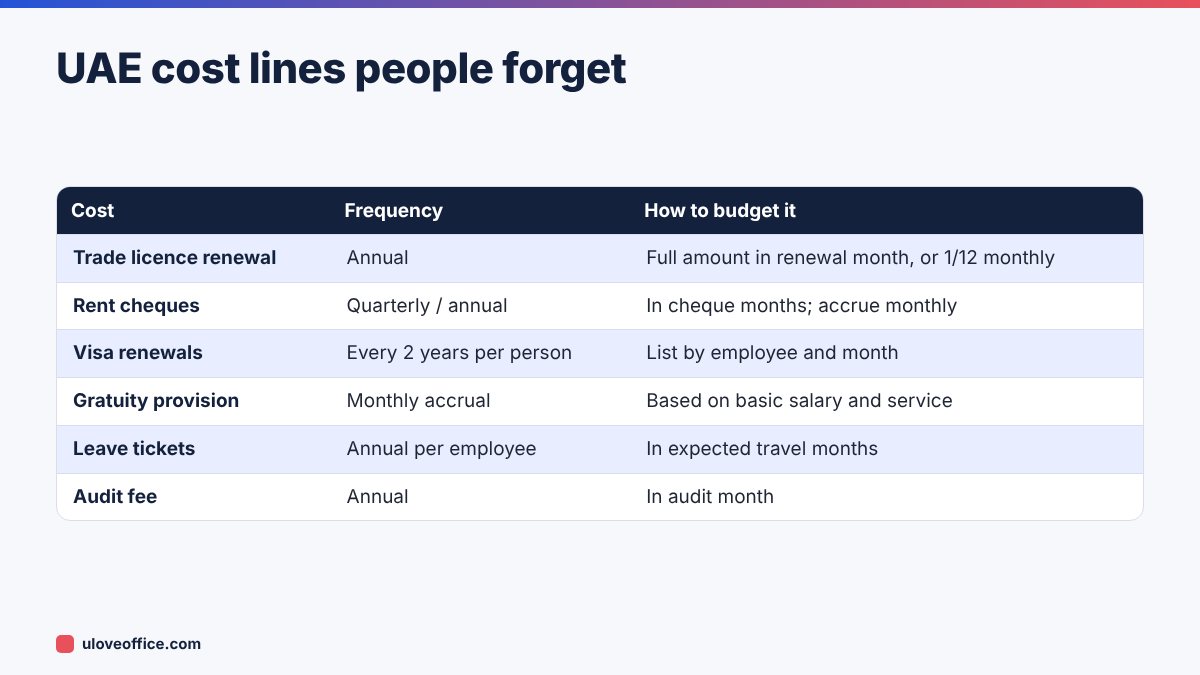
- Trade licence renewal (annual), plus any activity or permit fees.
- Office rent and service charges, often paid by post-dated cheques: quarterly, half-yearly or annually. Include Ejari registration renewal if applicable.
- Visa costs per employee: renewals, Emirates ID, medical test, and the costs of new hires.
- Health insurance for employees (mandatory in Dubai and Abu Dhabi and widely required elsewhere), and for dependants if you provide it.
- End-of-service gratuity provision: a monthly accrual so the liability is not a shock when someone leaves.
- Annual leave tickets if your contracts include them.
- WPS and bank charges.
- VAT payments on return due dates (if registered).
- Corporate tax (if taxable income exceeds the threshold and no relief applies).
- Audit and accounting fees, which some free zones require annually.
- Utilities: DEWA, SEWA, FEWA or ADDC, cooling charges in some buildings, internet and phones.
Step 1: Set up the sheet
In Excel, put categories in column A and months across columns B to M, with a total in N. Group rows:
- Revenue (by product, service or channel).
- Cost of sales (stock, subcontractors, delivery).
- Gross profit = revenue − cost of sales.
- Operating expenses (all the fixed and admin costs above).
- Operating profit = gross profit − operating expenses.
- Financing and tax (loan interest, corporate tax).
- Net profit.
Add separate “below the line” rows for cash items that are not expenses, such as loan principal repayments and VAT payments, if you want the budget to show cash too.
Step 2: Budget revenue realistically
Start from what you actually sold last year, month by month, and adjust for known changes: new contracts, lost customers, price changes, seasonality (Ramadan, summer slowdown, year-end peaks). Avoid using your sales target as the budget. A budget that is too optimistic leads to overspending.
For new businesses, build revenue from the bottom up: number of customers × average order × orders per month.
Step 3: Budget costs
- Salaries: list each employee with basic and allowances. Include planned hires from their start month and planned raises.
- Variable costs: as a percentage of revenue, based on last year’s margins. Use our Markup vs Margin Calculator to sanity-check pricing.
- Fixed costs: from contracts and invoices: rent, licence, insurance, subscriptions.
- Loan repayments: from the loan schedule, or calculate with our Loan EMI Calculator.
- VAT: if your prices exclude VAT, VAT collected is not your revenue. Track net VAT payable as a cash item in return months; use the UAE VAT Calculator to check amounts.
Step 4: Check break-even
Calculate the monthly revenue needed to cover fixed costs:
Break-even revenue = monthly fixed costs ÷ gross margin %
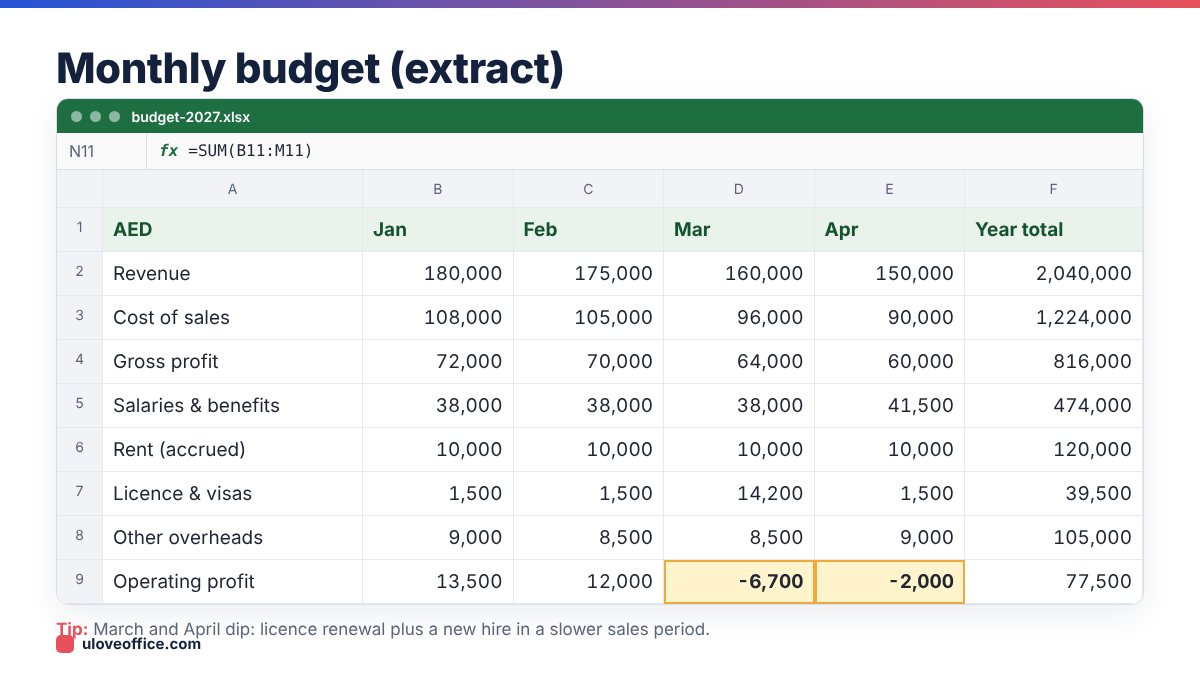
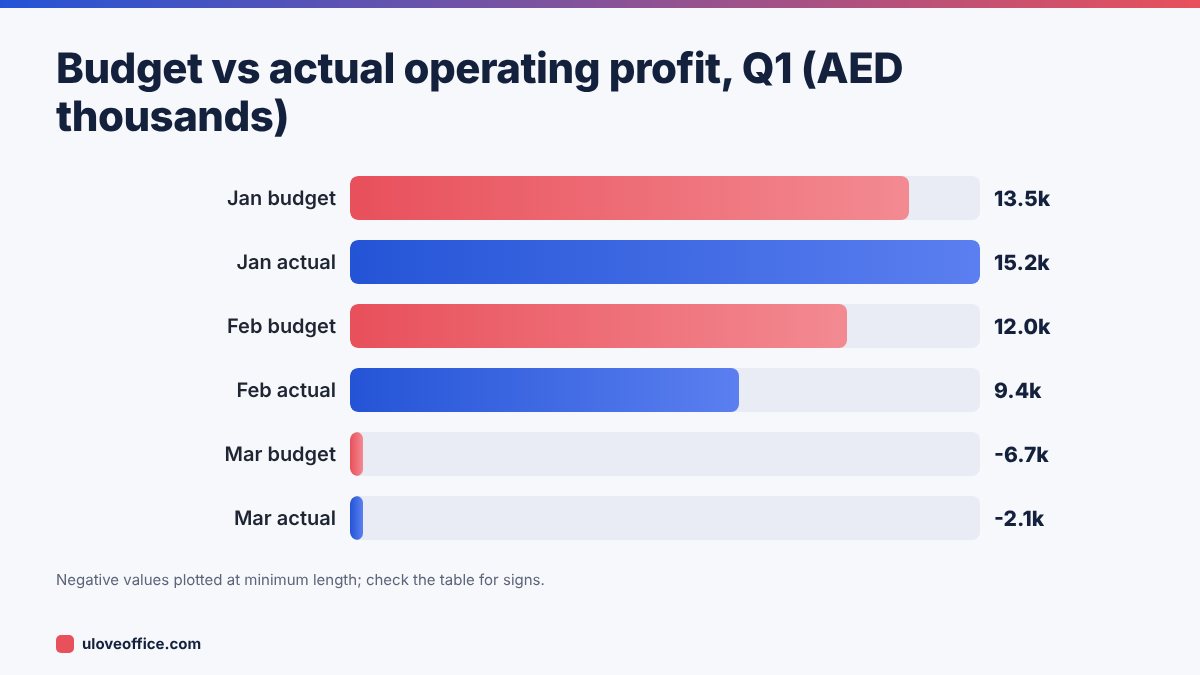
If fixed costs are AED 58,000 a month and gross margin is 40%, break-even revenue is AED 145,000. Any month budgeted below that will lose money. In the example above, March and April are close to or below break-even, so the owner can plan: cut discretionary spend, push sales, or move the new hire’s start date.
Step 5: Track budget vs actual
Add a second sheet with the same layout for actuals, filled from your accounting system each month. Then a variance sheet:
- Variance = actual − budget.
- Variance % = variance ÷ budget.
- Conditional formatting: red where costs are over budget by more than 10% or revenue is under budget by more than 10%.
Each month, write one line explaining each large variance. Over time you will see patterns, such as marketing costs creeping up or a product consistently selling less than planned.
Step 6: Review and reforecast
Review the budget with the owner or management monthly. Every quarter, update the remaining months for anything that has clearly changed (a big new contract, a lost customer, a rent increase). Keep the original budget for comparison, and add a “latest forecast” column.

Worked example: a 10-person trading company
A Sharjah trading company with ten staff and annual sales of about AED 2 million built its first budget. Listing UAE-specific costs revealed AED 39,500 of licence, visa and audit costs, most of them in March, plus a quarterly rent cheque in the same month. Revenue in March is usually lower because of Ramadan timing in 2027. The budget showed a loss in March and April. The owner moved two visa renewals’ paperwork earlier, delayed a planned hire by two months, and arranged a short overdraft facility in advance. The year still ended in profit, and the cash squeeze never happened.
Common mistakes
- Budgeting revenue at target, not realistic levels.
- Forgetting annual and biennial costs: licence, visas, audit, insurance.
- Ignoring gratuity: it is a real liability that builds every month.
- Mixing VAT into revenue when prices exclude VAT.
- Never comparing with actuals, so the budget becomes a forgotten file.
Building in contingency
Even the best budget is wrong in places. Add a contingency line of a few percent of operating costs for unexpected items: an urgent repair, a fine, a supplier price increase or a visa that needs reissuing. Keep it separate from other lines so you can see when you are using it. If you reach mid-year without touching the contingency, you can release it for planned investment.
Linking the budget to decisions
A budget is most useful when it guides real decisions. Before any significant spending, such as a new hire, a marketing campaign, a vehicle or new software, check three things against the budget:
- Is it in the budget? If not, what will you cut or which revenue will pay for it?
- What does it do to break-even? A new salary of AED 12,000 a month at a 40% gross margin needs AED 30,000 of extra monthly revenue to pay for itself.
- When does the cash leave? Use the 13-week cash flow forecast to check timing, especially if the cost involves annual or upfront payments.
Sharing it with your team
Department heads spend most of the money, so involve them. Give each manager a copy of their own cost lines and ask them to propose next year’s figures with reasons. Share the monthly variance report with them, too. People control costs better when they can see their numbers and understand the targets.
Choosing the right level of detail
Budget at the level you can actually control and track. If your accounting system records “Marketing” as one account, budget it as one line, with a note of planned campaigns. If you need more detail later, split the account in your accounting system first, so actuals can be compared line by line. A budget whose lines do not match the accounts takes hours to compare each month and is quickly abandoned.
Key takeaways
- Include UAE-specific costs: licence, visas, insurance, gratuity, rent cheques and VAT.
- Budget revenue realistically from last year’s actuals, adjusted for known changes.
- Check monthly break-even against budgeted revenue.
- Track actuals monthly, explain big variances and reforecast quarterly.
- Use the budget as the base for a weekly cash flow forecast.
📘 Continue reading
Frequently asked questions
Should the budget include VAT?
Revenue and costs are usually budgeted excluding VAT. Track VAT payments separately as a cash item.
How detailed should it be?
Detailed enough to manage, typically 20 to 40 lines. Too much detail makes it hard to update.
What if my business is new?
Build revenue bottom-up and be conservative. Review monthly and adjust more often in the first year.
Do free zone companies have different costs?
Yes: licence and facility fees, visa quotas linked to office space, and audit requirements vary by free zone. Use your actual invoices.
Conclusion
A monthly budget built for the UAE reality, with licence renewals, visas, insurance, rent cheques, gratuity and VAT, gives a small business clear sight of the year ahead. Set it up once, compare it with actuals every month, explain the gaps and update the forecast each quarter. You will make spending decisions with confidence instead of looking at the bank balance and hoping.
Last checked: 9 November 2026.