
Employee warning letter UAE: samples and the right process
Quick answer: A warning letter in the UAE should come at the end of a fair process, not the start. Investigate the issue, tell the employee in writing what they are accused of, give them a chance to respond, then decide. The letter itself should state the facts (dates, times, what happened), the rule or policy breached, any previous warnings, what improvement is expected, by when, and the consequences if it happens again. Ask the employee to sign to acknowledge receipt (not agreement) and keep a copy on file. The UAE Labour Law (Federal Decree-Law No. 33 of 2021) and its Executive Regulations list the disciplinary penalties an employer may apply, starting with a written warning, and set procedural requirements and time limits you must respect.
Warning letters matter for two reasons. They give the employee a clear, fair chance to improve. And if the employment ends later, they are the evidence that the employer acted reasonably. A vague, angry or rushed letter fails on both counts.
When a warning letter is appropriate
Common reasons include:
- Repeated lateness or absence without approval.
- Breach of company policy, such as data security, use of company vehicles or the AI use policy.
- Misconduct, such as rude behaviour towards colleagues or customers.
- Poor performance after informal coaching has not worked.
- Failure to follow reasonable instructions.
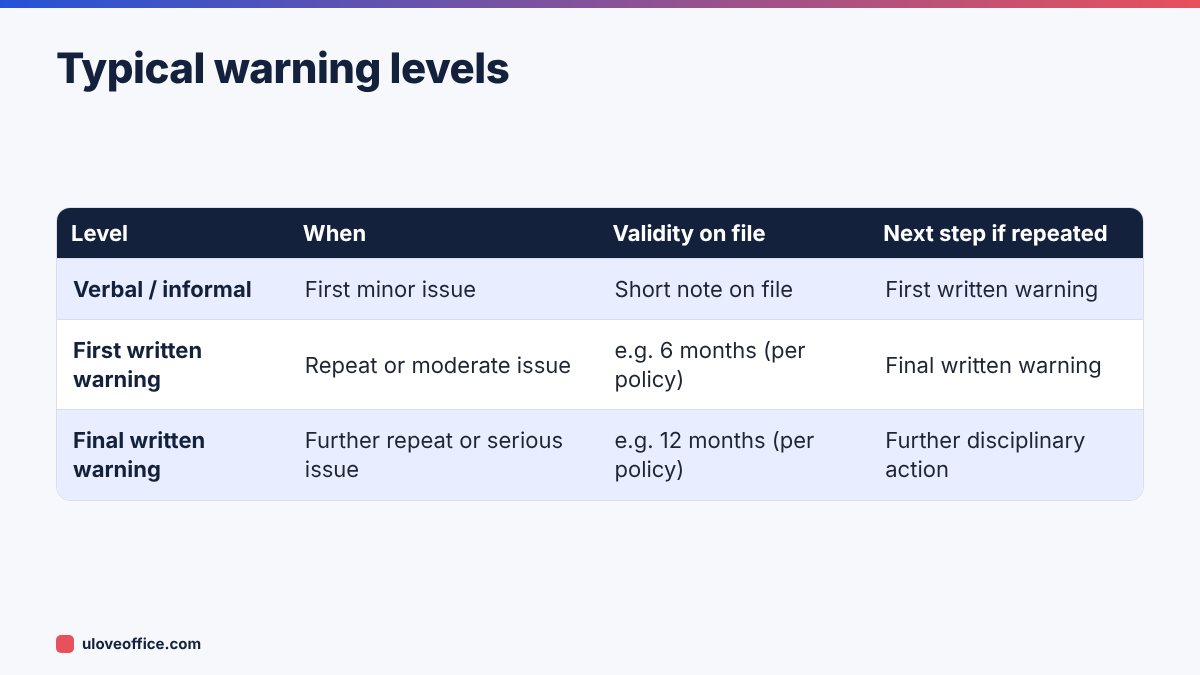
For a first minor issue, an informal conversation, recorded in a short note, is often better than a formal letter. Escalate to a written warning when the issue repeats or is more serious.
Very serious cases, such as theft, violence or serious breaches of confidentiality, may justify stronger action under the law. Take legal advice in those cases rather than relying on a template.
What the UAE Labour Law says
The Labour Law sets out the disciplinary penalties an employer may impose. In summary, they range from a written warning through salary deductions within legal limits, suspension for a limited period, deprivation of a periodic increment or promotion, up to dismissal in specified circumstances. Key principles:
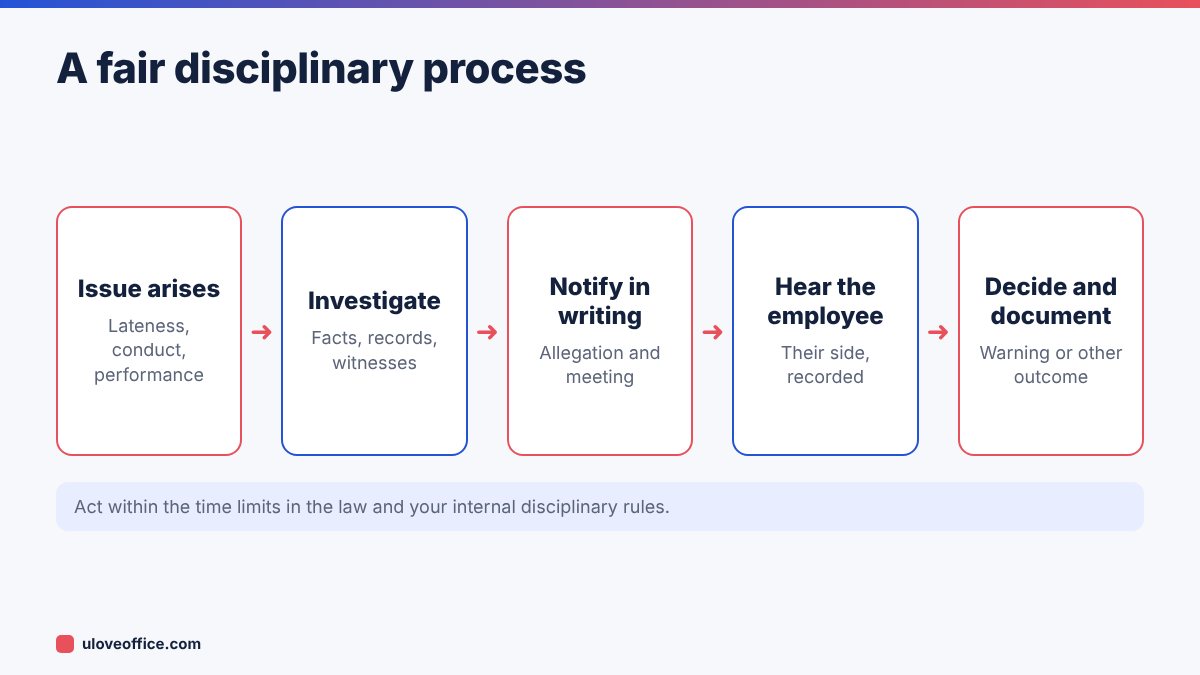
- The employee must be informed in writing of the allegation.
- The employee must have the opportunity to respond and defend themselves, and an investigation should take place before most penalties.
- Penalties must be proportionate and follow the company’s internal disciplinary rules.
- There are time limits for taking action after the employer learns of the violation.
- The penalty and its reasons must be communicated in writing.
Check the Executive Regulations for current details, and make sure your internal disciplinary policy is written, shared with employees and consistent with the law.
What to include in a warning letter
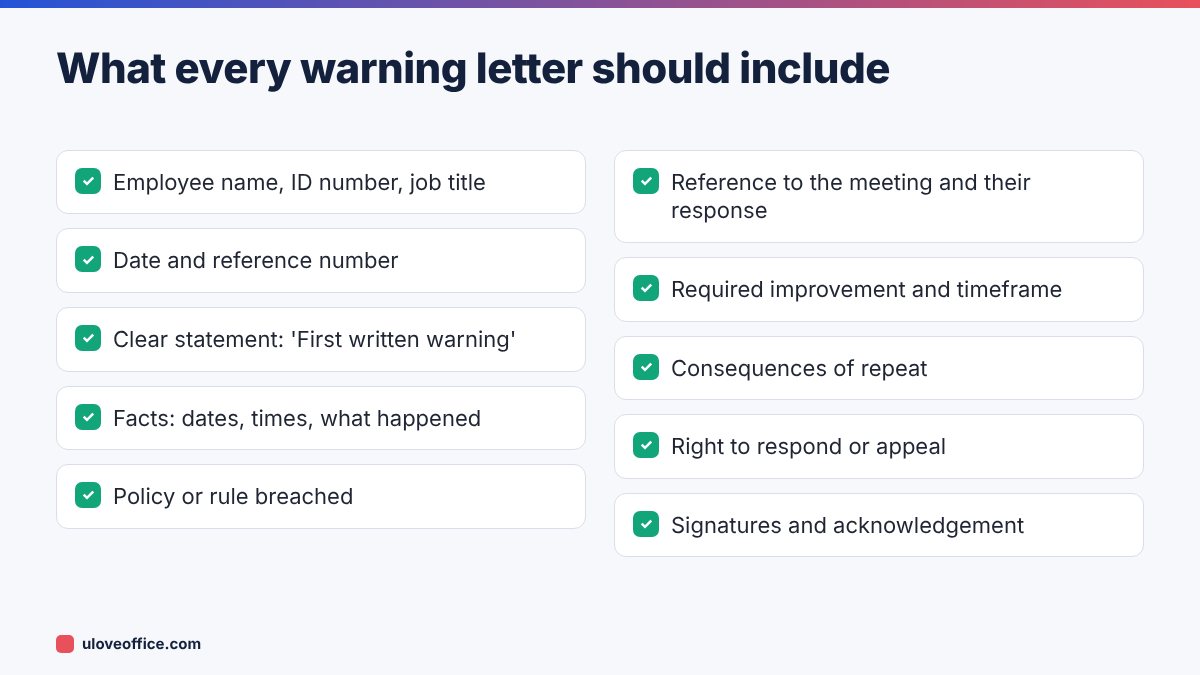
Be specific. “You arrived late on 3, 5, 10, 12 and 17 November 2026, between 25 and 50 minutes after your 9:00 start” is evidence. “You are always late” is an opinion.
Stay factual and calm. Avoid adjectives like “unacceptable attitude” or “lazy”. Describe behaviour, not character.
Refer to the process. Mention the date of the meeting and summarise the employee’s explanation. This shows they were heard.
Set clear expectations. “From 1 December 2026 you must arrive by 9:00 each working day. If you will be late, inform your manager before 9:00.”
State the consequence. “Further lateness during the next three months may lead to a final written warning or other disciplinary action under company policy.”
Sample: first written warning (lateness)
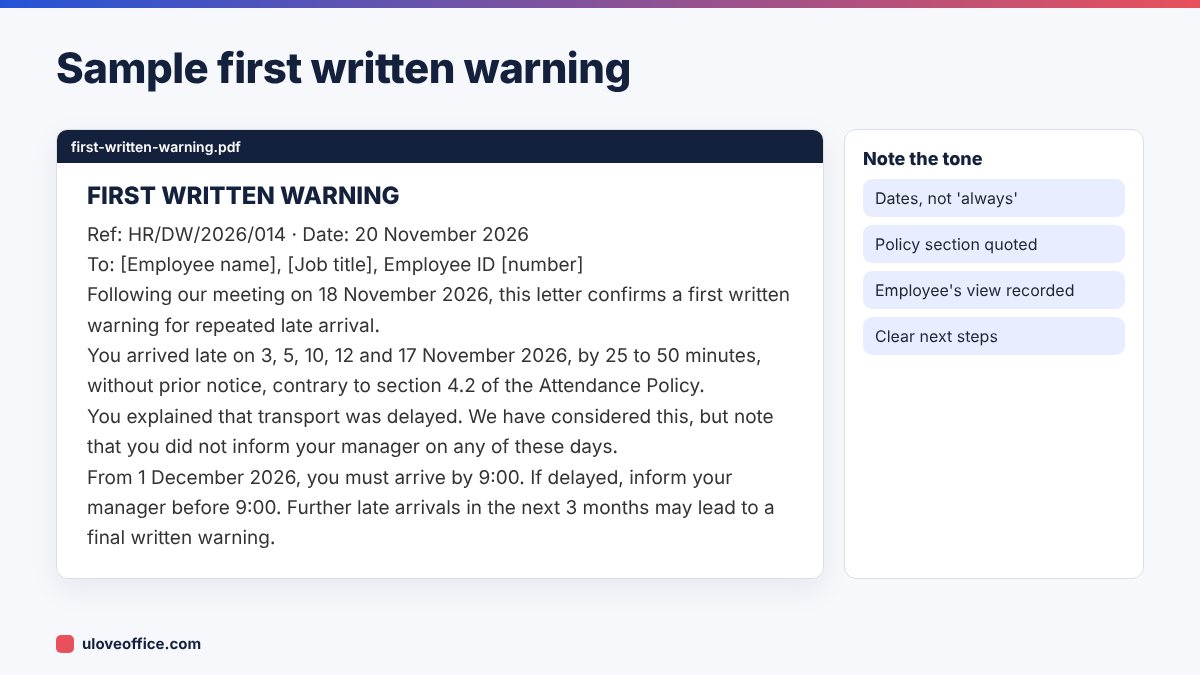
The full letter should close with: “You may submit a written response within five working days, which will be kept on your file. Please sign below to confirm you have received this letter. Signing does not mean you agree with its contents.” Then add the manager’s and HR’s signatures and an acknowledgement line for the employee.
Sample: final written warning (policy breach)
A final warning follows the same structure with three differences:
- It is titled “Final Written Warning”.
- It refers to the previous warning by date and reference number, and to what has happened since.
- It states clearly that any further breach may lead to termination of employment in line with the Labour Law and company policy.
Example wording: “On 20 November 2026 you received a first written warning (ref HR/DW/2026/014) for late arrival. Since then you have arrived late on 8 and 15 January 2027 without notice. This letter is a final written warning. Any further breach of the Attendance Policy within the next six months may result in termination of your employment in accordance with the UAE Labour Law and company policy.”
Delivering the letter
- Deliver it in a private meeting, with HR present if possible. Do not email it out of the blue.
- Give the employee time to read it and ask questions.
- Ask for a signature acknowledging receipt. If the employee refuses to sign, note “refused to sign” with the date, time and the names of witnesses. The letter is still valid as a record that it was given.
- Give the employee a copy.
- File the signed original in their personnel file.
Save the signed letter as a PDF, and protect it with Protect PDF if you email it. If the employee signs electronically, use eSign PDF.

Arabic and English versions
If an employee does not read English well, provide the letter in a language they understand, often Arabic or their first language, or explain it with a translator present and note this on the letter. A warning the employee could not understand is weak evidence. For translation help, see our guide to translating business documents between Arabic and English with AI, and always have important letters checked by a fluent speaker.
Common mistakes
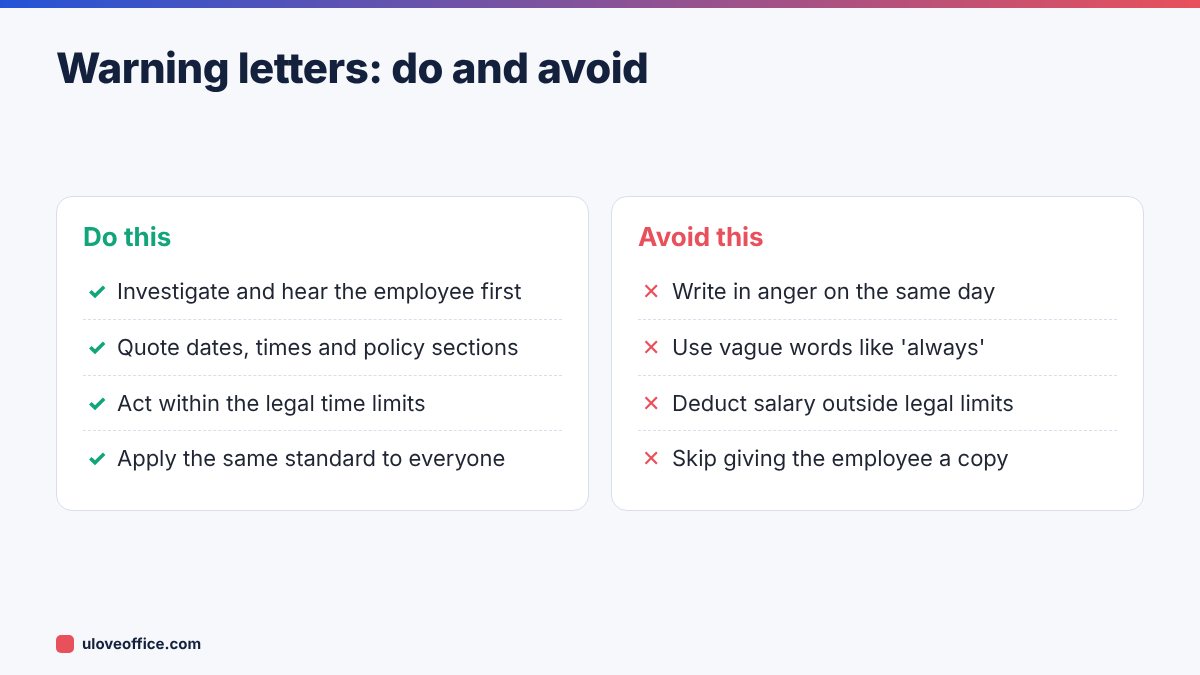
- No investigation or hearing. The letter appears as a decision made without listening.
- Inconsistent treatment. Warning one employee for something others do freely invites complaints.
- Waiting too long. Acting months after the event weakens the warning and may breach time limits.
- Mixing issues. Combine performance and conduct only if they are genuinely linked; otherwise use separate processes.
- Using warnings as a substitute for management. A warning should follow coaching and clear expectations, not replace them.
Performance warnings
For performance issues, the warning should reference the employee’s objectives, the evidence of underperformance, the support provided (training, coaching) and a performance improvement plan with measurable targets and a review date. Our guide to employee performance review examples has phrases and rating scales you can use.
Keeping disciplinary records properly
Disciplinary files are sensitive personal data. Keep them in a restricted HR folder, not in the manager’s email. For each case, keep together: the investigation notes, the written notice of the allegation, the meeting notes with the employee’s response, the warning letter, the acknowledgement or refusal note and any written response from the employee. Name files consistently, for example 2026-11-20_EmployeeID_FirstWarning_Lateness.pdf, and merge the case documents into one file with Merge PDF when the case closes.
Record the expiry date of each warning in your HR tracker. When a warning expires under your policy, note it on the file, so it is not relied on later by mistake.
Worked example: from coaching to final warning
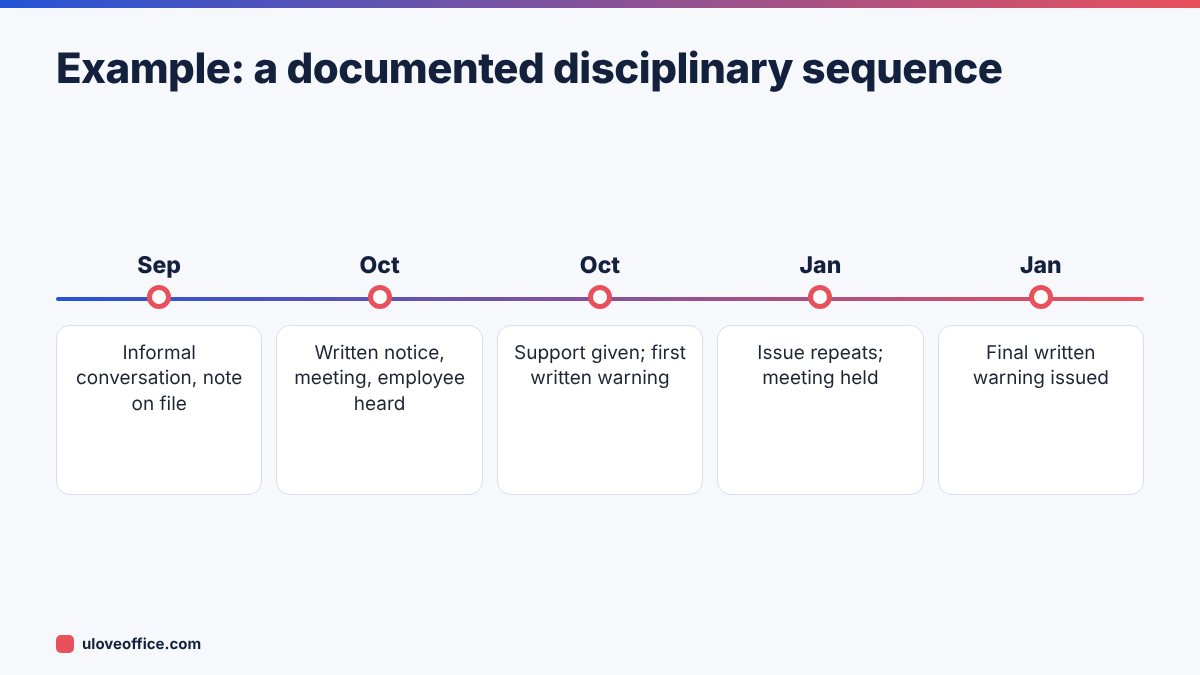
A sales coordinator in a Dubai trading company repeatedly missed the deadline for updating the CRM at the end of each day. The manager first raised it informally in a one-to-one and recorded a short note. A month later the problem continued. HR wrote to the employee describing the missed dates, invited them to a meeting, and heard their explanation: the CRM was slow on their old laptop. The company replaced the laptop and issued a first written warning that recorded the explanation, the support provided and the expectation of daily updates. Performance improved for two months, then slipped again without any new explanation, and a final written warning followed. The file showed a fair, documented sequence at every step.
Key takeaways
- Follow the process: investigate, notify in writing, hear the employee, then decide.
- Write facts, dates and policy references, not opinions.
- State the improvement required and the consequences clearly.
- Get the letter acknowledged, give a copy and file the original.
- Apply your disciplinary policy consistently and within legal time limits.
📘 Continue reading
Frequently asked questions
Is a warning letter required before termination in the UAE?
It depends on the reason for termination and the circumstances. Warnings are strong evidence of a fair process, especially for performance and repeated minor misconduct. Take legal advice before terminating.
Can I deduct salary as a penalty?
The Labour Law allows deductions as a disciplinary penalty only within specific limits and procedures. Follow the law and your disciplinary rules carefully.
What if the employee refuses to sign?
Note the refusal with witnesses’ names and the date. The warning still stands as a record.
How long does a warning stay on file?
Your disciplinary policy should state how long warnings remain active for further disciplinary purposes.
Conclusion
A good warning letter is calm, specific and fair. Investigate first, hear the employee, then write down the facts, the policy breached, the improvement expected and the consequences of a repeat. Deliver it privately, get acknowledgement and file it. Done this way, the letter gives the employee a genuine chance to improve and protects the business if things do not change.
This article is general information, not legal advice. Last checked: 9 November 2026. Consult MOHRE guidance or a UAE employment lawyer for specific cases.