
How to lock cells and protect formulas in Excel
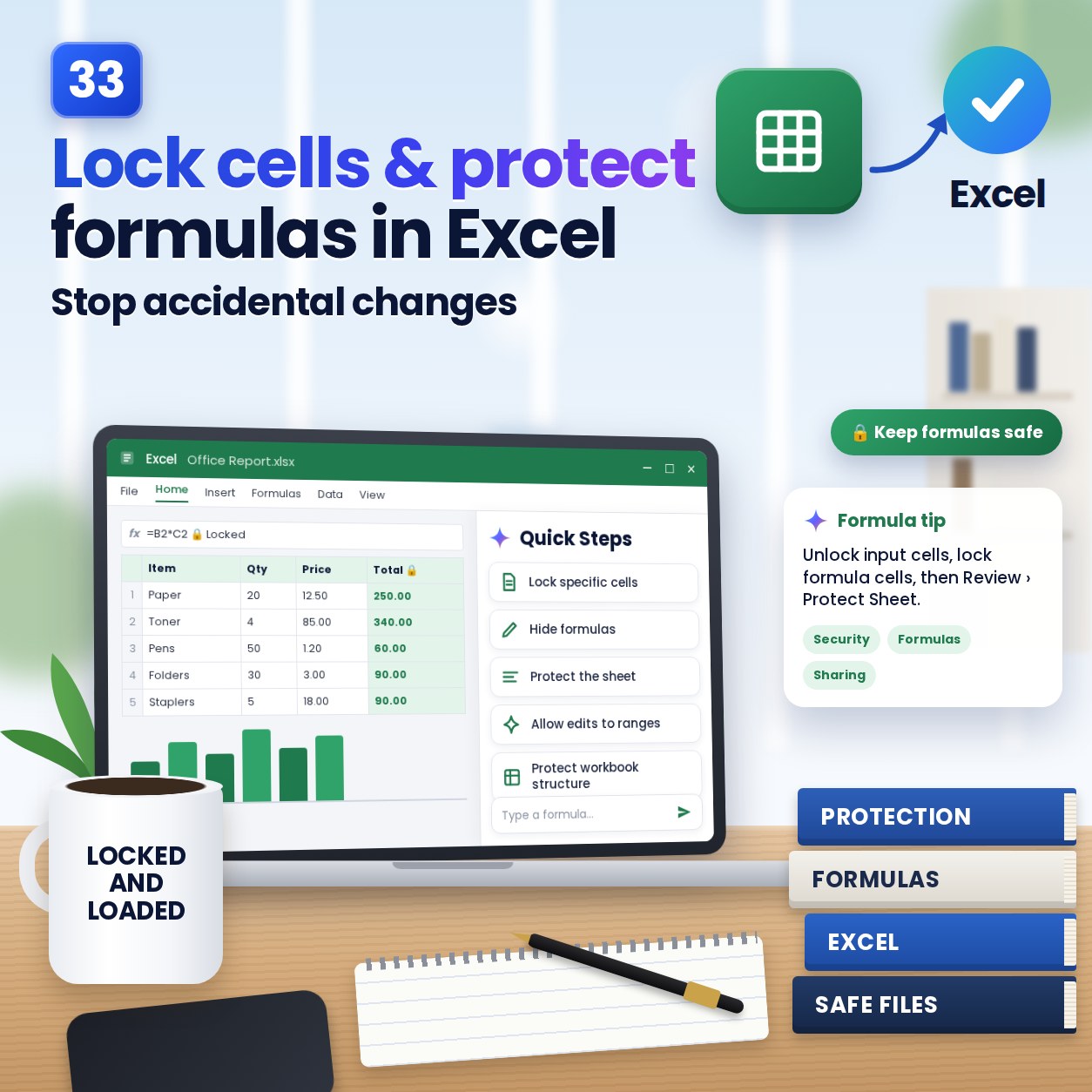
Quick answer
How to lock cells and protect formulas in Excel is a practical problem for office workers because the fastest method is not always the safest or most maintainable one. This guide focuses on the keyword “lock cells excel” and shows a repeatable workflow, realistic office examples, checks that prevent common errors, and decisions a reader should make before sharing the final result. The goal is not to add another thin tutorial to the web: it is to give a general office user enough context to complete the task, verify the result, and explain the method to a colleague.
For software instructions, menus can vary slightly by desktop, web and mobile versions, so use the underlying workflow rather than memorizing one screen.
Before you start
Begin by defining what success looks like for lock cells excel. A good office workflow has three qualities: the result is correct, another person can understand how it was produced, and the source information remains recoverable. Create a working copy when the task changes files or data.
Note any constraints such as confidentiality, deadlines, approval requirements, file-size limits, or company policies. If the task uses AI, remove unnecessary personal or confidential information and follow your organization’s approved-tool policy. If the task uses spreadsheets, keep raw data separate from calculations.
If it changes a PDF or email workflow, test on a non-critical file or message first. These simple controls prevent most avoidable office mistakes.
Step-by-step workflow
Step 1: Convert the source range into a clean table with one header row.
Step 2: Check data types: dates must be dates, numbers must be numeric and IDs should remain text where appropriate.
Step 3: Build the formula on a small sample before filling it down.
Step 4: Use absolute or structured references where the logic requires them.
Step 5: Test blanks, duplicates, errors and boundary cases.
Step 6: Document the formula so another office worker can maintain the workbook. While following these steps for lock cells excel, write down any choice that changes the result. This is especially useful when a manager asks why a number, document version or generated summary differs from an earlier version. A short note in the workbook, document comments, or project log is usually enough.
Worked office example
Consider a Dubai-based operations team preparing a monthly report with an AED 125,000 operating budget. The team needs to use lock cells excel as part of the reporting process. Instead of working on the only copy, the coordinator duplicates the source, labels the reporting period, applies the method on a small sample, and checks the result against a manually verified record.
Only after that check is the method applied to the full dataset or document. This creates an audit trail and makes errors easier to reverse.
How to check the result
Verification is part of the task, not an optional final polish. Compare at least one result with the source material. Check dates, currency, names, totals, page counts, formulas, links and file names as relevant.
For AI-generated text, confirm every factual statement that could affect a decision. For spreadsheet formulas, test a normal case, a blank, a zero, and an unusual value. For documents, inspect the first page, a middle page and the last page after conversion.
For email automation, confirm both the positive condition and an exception. A five-minute verification step is usually cheaper than correcting a circulated error.
Common mistakes and how to avoid them
The most frequent problems are: mixing numbers stored as text with true numbers; hard-coding values that should be cell references; forgetting absolute references when copying formulas; using entire-column calculations in unnecessarily large workbooks; ignoring blanks and error values; editing raw data instead of keeping a clean source copy. The pattern behind these mistakes is the same: users optimize for speed before defining controls. A better approach is to make the first attempt small and reversible.
Once the method works, scale it. If the result will be sent to customers, employees, management or a regulator, use a second-person review for important facts and figures.
A practical checklist
Use this checklist before you finish: confirm the source is current; preserve the original; use a descriptive filename; check the output against at least one known example; review formatting; remove comments or temporary notes that should not be shared; confirm permissions and confidentiality; make sure links or formulas still work; export to the required format; and open the final file once more after export. For recurring work, save the validated process as a short SOP so the next monthly or weekly cycle takes less time.
When this method is not enough
Not every lock cells excel task should be solved with a quick office technique. Stop and escalate when the source data is incomplete, the result affects payroll or legal rights, a document contains highly sensitive information, a formula produces inconsistent totals, a PDF appears corrupted, or an AI system cannot show where a critical fact came from. The correct office skill is sometimes recognizing that the task needs an administrator, HR specialist, accountant, lawyer, IT team or the document owner.
Escalation is not inefficiency when the cost of a wrong answer is high.
How to make the workflow faster next time
After the first successful run, convert repeated decisions into a template. Name the required inputs, the output format, the reviewer and the final storage location. For AI tasks, keep a prompt library with placeholders instead of copying confidential examples.
For Excel, use structured tables and clear column names. For PDFs, keep a predictable source/final folder structure. For Outlook or Workspace tasks, document rule conditions and exceptions.
The aim is controlled reuse: automation should remove repetitive clicks without removing the checks that protect accuracy.
Quality-control framework
A useful way to judge any office technique is to separate input quality, transformation quality and output quality. Input quality asks whether the source is complete and correctly typed. Transformation quality asks whether the formula, prompt, conversion or rule actually represents the business requirement.
Output quality asks whether the final file or message is readable, shareable and appropriate for its audience. Many office errors occur because only the middle stage receives attention. A perfect formula cannot repair a wrong source date; a polished PDF cannot make an unverified statement accurate; and a fluent AI summary cannot replace missing evidence.
For recurring work, measure the process by error rate and review time as well as speed. A workflow that saves ten minutes but creates a weekly correction is not efficient. Where possible, create one known-good test case and retain it.
Re-running that case after a software update, template change or process handover is a simple form of quality control.
Frequently asked questions
What is the easiest way to start with lock cells excel?
Start with a small, reversible example using non-critical data. Confirm the result, then apply the same method to the full task.
Do I need paid software?
Not always. The requirement depends on the feature and file type. Some AI and advanced office features require eligible plans, while many document and spreadsheet tasks can be completed with built-in or browser-based tools.
How do I avoid losing my original work?
Keep an untouched source copy and save the processed version under a new, descriptive filename.
Can I use the same steps on Mac and the web?
Usually the underlying workflow is similar, but buttons and feature availability can differ. Check the current interface and product documentation.
What should I verify before sharing the result?
Check names, dates, numbers, formulas, page layout, links, permissions and any factual claim that could affect a decision.
Is AI output safe to publish as-is?
No. Treat generated content as a draft. Add original examples and editorial judgment, and verify factual claims before publication.
How can a team make this repeatable?
Turn the validated process into a short SOP or template with inputs, steps, review points and a clear final-output location.
Conclusion
How to lock cells and protect formulas in Excel becomes much easier when the task is treated as a controlled workflow rather than a one-click trick. Preserve the source, use the method on a small sample, verify the output and document anything another person may need to reproduce. Use ULoveOffice Excel and file tools when you need to clean, convert or prepare office data before analysis.